Pakistan’s illegal economy is not a peripheral border problem. It is a market-structure problem that changes prices, rewards noncompliance, shifts demand away from documented supply chains, and weakens the credibility of the state as a regulator. When illegal operators can consistently undercut lawful firms in large, everyday markets, investors read the signal clearly: compliance carries cost, but enforcement is uncertain. Over time, that combination discourages capital formation, reduces productivity upgrades, and pushes even legitimate businesses toward defensive behavior, lower footprints, and cash-first operating models.
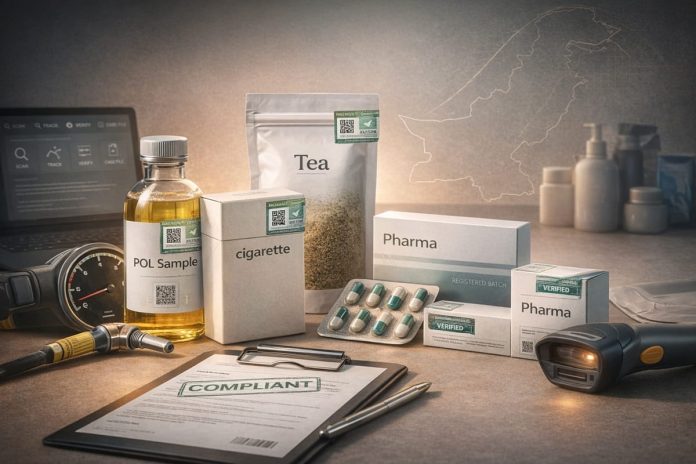
Any government can announce higher rates, tougher penalties, and new systems. The practical question is whether enforcement can protect the tax base in the markets that matter most for revenue stability and competitiveness. In Pakistan, five private-sector markets stand out because they are large, widely consumed, and routinely flagged by credible business and research sources as high-risk for smuggling, counterfeiting, under-invoicing, misdeclaration, and adulteration. Those markets are petroleum products (POL), tobacco and cigarettes, FMCG and consumer products, tea, and pharmaceuticals. Together, they shape the daily integrity of retail and distribution, the reliability of indirect taxes, and the perceived fairness of competition.
The Pakistan Business Council (PBC) frames the problem at system scale, estimating that smuggling, under-invoicing, misdeclaration, counterfeiting, and adulteration together amount to about $68 billion per year, around 20 percent of the formal economy, with an associated tax loss estimated at about Rs. 8 trillion. That tax loss is described as close to 85 percent of the FY2024 federal tax target. Separately, a TRACIT report prepared with PRIME Institute estimates that tax evasion and illegal trade are equivalent to about 6 percent of GDP, and that sector-specific leakages in everyday markets are now large enough to weaken fiscal capacity and economic competitiveness. Taken together, these assessments explain why investor confidence is increasingly tied to the state’s ability to keep large consumer markets inside the documented economy.
Scale Snapshot, What Public Estimates Indicate
| Sector | Market footprint, public proxy | What the illegal economy looks like | Estimated annual fiscal leakage tied to illegal trade (published estimates) |
| POL (petrol and diesel) | Pakistan’s oil import bill was reported at about $11.2 billion in FY2024 | Cross-border fuel inflows, coastal routes, informal retail, blending and distribution in weakly monitored corridors | About Rs. 270 billion in tax loss; also reported as linked with 2.8 billion liters smuggled from Iran |
| Tobacco and cigarettes | Cigarettes are consistently cited as the single largest contributor to Federal Excise Duty; FBR reporting shows large absolute collections even when the share fluctuates | Smuggled packs, illegal domestic production, noncompliant retail, and weak chain controls | Rs. 300 billion (one published estimate), and “untaxed cigarette sales” draining around Rs. 415 billion (another published estimate) |
| FMCG and consumer products | PBC lists consumer categories most exposed to illegal trade, including cosmetics and toiletries, food items, and domestic appliances | Counterfeiting, adulteration, under-invoicing, and undocumented retail channels | Not consistently quantified as a single headline number by category; PBC reports FMCG companies estimate losses around 5 percent of turnover and that large shares of goods in undocumented outlets can be illegal |
| Tea | Pakistan consumes over 200,000 tons annually (reported estimate) | Smuggling and adulteration, driven by tax differentials | Roughly Rs. 10 billion in annual tax loss; illegal trade estimated around 30 percent market share |
| Pharmaceuticals | Pakistan’s pharma market was reported around Rs. 1.049 trillion at retail prices | Counterfeit and substandard medicines, weak oversight across jurisdictions, illegal diversion | Roughly Rs. 60 to 65 billion in annual losses; one estimate claims about 40 percent of medicines can be counterfeit or substandard |
A conservative and practical reading is that documented annual tax leakage in just four of these sectors, POL, cigarettes, tea, and pharmaceuticals, can exceed Rs. 400 to 700 billion depending on which credible estimate is applied for cigarettes, and TRACIT separately aggregates tea, tyres, lubricants, and pharmaceuticals losses at about Rs. 160 billion while citing untaxed cigarette sales at around Rs. 415 billion. The broader PBC system estimate is much larger because it includes multiple channels and product groups beyond these five markets.
POL: The Illegal Fuel Economy as a Direct Threat to Revenue Predictability
POL is a uniquely sensitive market because the tax component is large and immediate. Petroleum development levy and other duties are designed to be captured reliably through documented imports, refining, and registered distribution. When significant volumes enter outside the legal channel, the state loses revenue, but lawful firms also lose the predictability needed for inventory planning, investment in storage and retail assets, and compliance upgrades.
TRACIT describes sustained growth in Iranian fuel smuggling through Balochistan, referencing daily cross-border vehicle movements and coastal transport routes, and ties the problem to a reported 2.8 billion liters of petrol and diesel smuggled from Iran and an associated tax loss of around Rs. 270 billion. This form of illegal trade does not only reduce receipts, it creates a parallel pricing regime. That pricing regime forces lawful companies to compete against products that do not carry comparable taxes and compliance costs, a market distortion that discourages investment in formal logistics, upgraded retail, and modern compliance systems.
Investor confidence is affected in two linked ways. One effect is direct, because fuel is a foundational input for production and transport across the economy, and illegal fuel supply undermines pricing stability and documentation integrity. The second effect is signaling, because if a heavily taxed national commodity cannot be protected from systematic illegal trade, investors assume similar weaknesses exist in other markets as well.
Tobacco and Cigarettes: A Major Private-Sector Tax Base Undermined by a Parallel Market
The cigarette sector matters disproportionately because it historically anchors Federal Excise Duty receipts. FBR yearbook-based reporting has repeatedly described cigarettes as the top contributor to Federal Excise Duty, with shares around 40 percent in some recent years, even though the share can fall when the illegal market expands. More recent reporting, citing FBR data, shows cigarette FED collections around Rs. 225.495 billion in FY2025, alongside an explicit warning that the decline in share reflects expansion in illegal cigarette trade.
On the loss side, TRACIT presents two important signals. One is the magnitude of the drain, citing untaxed cigarette sales draining around Rs. 415 billion annually. Another is a commonly used policy estimate of around Rs. 300 billion in annual loss, cited alongside minimum legal price benchmarks by tier and the reality that pricing differentials are the fuel of illegal trade. The range itself is meaningful, because it indicates the problem is not marginal. Even the lower published estimate implies a revenue loss that can fund major public priorities without raising rates on compliant taxpayers.
The investor impact is straightforward. First, illegal cigarettes create a market where compliant operators face shrinking share even when demand remains stable, because the cheapest substitute is non-tax-paid product. Second, repeated rate increases without enforcement capacity can widen the price gap that makes illegal supply more attractive, shifting consumption away from documented channels. Third, the presence of a large parallel market undermines confidence in Track and Trace and chain controls, which are precisely the mechanisms investors look for when they assess regulatory seriousness and rule consistency.
FMCG and Consumer Products: Counterfeiting, Adulteration, and the Documentation Collapse
Consumer products have two traits that make them highly exposed to illegal trade. High volume means low margins, so counterfeiters and under-invoicers can gain share quickly. Broad retail penetration means enforcement must work through supply chains, not only through occasional seizures.
PBC’s framework highlights that consumer categories such as cosmetics and toiletries, food items, and domestic appliances are among the vulnerable items in the illegal economy, and it notes that companies in the FMCG sector estimate losses around 5 percent of their turnover due to smuggling and counterfeiting. The same framework also points to the structural role of undocumented outlets, citing that large shares of goods sold through such channels can be illegal. This is the core investor problem in consumer products. If a firm invests in brand protection, quality, packaging compliance, and documentation, while competitors capture share through fake and smuggled substitutes, returns on lawful investment become uncertain.
The damage is not limited to revenue loss. Consumer-product counterfeiting undermines trust in quality and safety, and that undermines long-term market development. It also weakens formal retail modernization, because modern trade depends on verifiable sourcing and product authentication.
Tea: A High-Consumption Import Where Illegal Trade and Adulteration Persist
Tea is not an excise-driven market like cigarettes, but it is large in household consumption and highly exposed to smuggling incentives when import duties and sales taxes create a price wedge. TRACIT describes Pakistan as among the world’s largest tea-consuming nations, with consumption exceeding 200,000 tons annually, and estimates that illegal tea trade accounts for roughly 30 percent of the market with an annual tax loss of about Rs. 10 billion.
From an investor perspective, tea illustrates a broader point. When the state cannot reliably protect high-volume imported consumer goods from illegal channels, the market trains itself to accept uncertain standards, mixed quality, and cash-driven distribution. That reduces incentives for investment in packaging, traceability, documented wholesaling, and modern retail integration.
Pharmaceuticals: Counterfeit Medicines as a Governance and Investment Failure
Pharmaceuticals carry a distinct risk profile. Counterfeit and substandard medicines harm public trust and raise ethical and regulatory exposure for legitimate manufacturers, importers, and distributors. TRACIT describes an estimated 40 percent of medicines sold domestically as counterfeit or substandard, and it highlights fragmentation in oversight, with federal control over production and licensing and provincial oversight over distribution, a division that can weaken enforcement coordination. TRACIT also quantifies annual losses in pharmaceuticals at roughly Rs. 60 to 65 billion.
Market scale matters here. Reporting based on PPMA and IQVIA estimates places Pakistan’s pharmaceutical market around Rs. 1.049 trillion at retail prices. When investors see large market size combined with weak chain integrity and fragmented regulation, they factor higher compliance costs, litigation exposure, and reputational risk into investment decisions. That pushes capital toward lower-risk jurisdictions unless the state demonstrates sustained control over distribution, inspections, and prosecutions.
Why Sustained Crackdown Becomes an Investment Policy, Not Only an Enforcement Campaign
The common thread across these markets is not simply smuggling. The common thread is that illegal trade changes expected returns on lawful investment. It rewards the shortest, least documented supply chain, and it punishes firms that carry full tax and compliance burdens. The World Bank’s Enterprise Survey framing treats competition from informal firms as a meaningful obstacle in business environments, and IMF analysis of illegal financial flows emphasizes how illegal systems distort competition, lower tax receipts, and weaken capital available for private investment. UNCTAD also describes investment facilitation and policy certainty as central tools used by developing countries to attract investment.
In Pakistan’s context, a “hard and sustained crackdown” is best understood as a package of predictable enforcement, credible monitoring systems, and chain integrity tools such as Track and Trace where applicable. In POL, that means disrupting the economics of illegal distribution, not only intercepting shipments. In cigarettes and tobacco, that means treating Track and Trace as a system with enforcement consequences at retail and production, not as a technology installed in isolation. In pharmaceuticals, that means coordinated federal-provincial enforcement and inspection capacity that matches market scale. In FMCG and consumer products, that means brand-protection enforcement and supply chain documentation that makes counterfeiting a high-risk business model.
A final point is that Pakistan does not need perfect elimination to gain economic benefit. If enforcement can reliably reduce market shares of illegal supply in these five sectors, the state recovers revenue, lawful firms regain share, and investors see that compliance is a winning strategy. That shift, more than any single announcement, is what improves the credibility of the investment environment.
Conclusion
Pakistan’s investor confidence problem is partly macroeconomic, but it is also deeply commercial. Investors want to see whether the state can protect documented commerce in high-volume markets that touch every household and every supply chain. Public estimates from PBC and TRACIT, combined with market data for pharma and the recurring revenue centrality of cigarettes, make the case that POL, tobacco, consumer products, tea, and pharmaceuticals are the practical test markets for rebuilding credibility. If Pakistan sustains pressure on illegal supply chains in these sectors, the payoff is not only revenue recovery. The payoff is a cleaner competitive landscape where lawful businesses invest, expand, and formalize supply chains with confidence that the state will enforce the rules consistently.