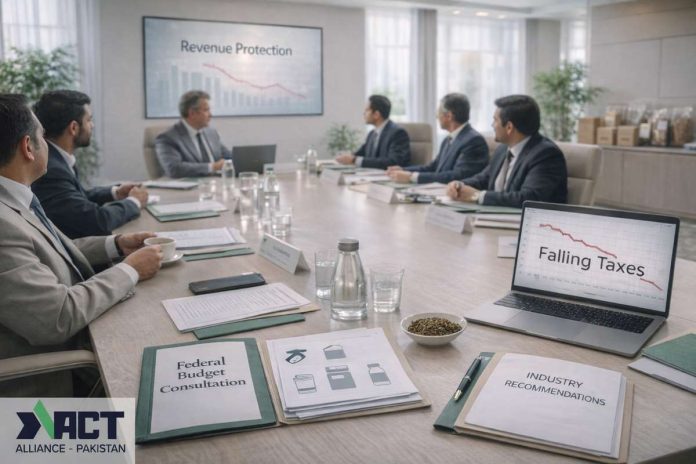
Islamabad – ACT Alliance has urged the Government of Pakistan to formally expand its budget consultation process and begin accepting practical, written recommendations from the private sector, particularly from the country’s leading taxpaying industries, including petroleum, oil, and lubricants; tobacco and cigarette manufacturing; tea; pharmaceuticals; and consumer products.
Mubashir Akram, Country Director of ACT Alliance, said that an industry-informed budget is necessary to strengthen documented economic activity, improve compliance, and protect national revenue. “Pakistan’s top taxpaying industries operate within the documented economy, invest in jobs and supply chains, and contribute directly to the revenue base. The upcoming federal budget should be designed to reward compliance, reduce distortions, and make it easier for legitimate businesses in petroleum, oil, and lubricants, tobacco, tea, pharmaceuticals, and consumer goods to contribute more to national growth and economic development,” he said.
Public finances, he added, face sustained pressure when policy is crafted without structured engagement with the sectors that carry a large share of tax contribution.
“A budget that is industry-friendly does not mean leniency or special treatment. It means clarity, predictability, fair enforcement, and a level playing field that makes compliance the rational business choice,” Akram said. “When legitimate companies can plan, invest, and expand, the result is higher production, more formal employment, stronger exports where relevant, and improved revenue outcomes for the state.”
ACT Alliance also appreciated the Government of Pakistan and enforcement agencies for continuing action against illegal trade and tax evasion. It called for that momentum to be sustained across key revenue-sensitive sectors. “Government actions against illegal trade in petroleum, oil, and lubricants, tobacco, tea, pharmaceuticals, and consumer products are essential for protecting the tax base and discouraging criminal market capture,” Akram said. “Policy reforms in the budget must work in parallel with enforcement. When illegal supply chains are allowed to undercut compliant businesses, the state loses revenue, consumers are exposed to unregulated products, and compliant taxpayers are penalized for following the law.”
Further emphasizing the urgency, Akram noted that consultation should not be limited to broad, ceremonial engagement. “Structured and transparent consultations, with documented submissions and measurable follow-through, will improve credibility and outcomes. Recommendations from the petroleum, oil, and lubricants sector, tobacco and cigarette manufacturers, tea importers and producers, pharmaceutical companies, and consumer products firms can help the government identify practical reforms that strengthen compliance, reduce leakage, and expand the documented economy,” he said.
In addition, ACT Alliance called for the federal budget to prioritize measures that simplify compliance and reduce incentives to engage in informality. “A predictable tax and regulatory environment encourages investment, while inconsistent enforcement and policy uncertainty increase the space for illegal operators,” Akram said. “The budget should reinforce the principle that those who comply and pay must be protected from those who evade, smuggle, counterfeit, or operate outside the documented economy.”
ACT Alliance concluded by reaffirming its support for national revenue protection and market fairness. “Pakistan needs a budget framework that empowers lawful economic activity and closes the space for illegal trade,” Akram said. “Consulting the top taxpaying industries in petroleum, oil, and lubricants, tobacco, tea, pharmaceuticals, and consumer products is a practical step toward higher revenue, stronger growth, and a more stable economic trajectory.”