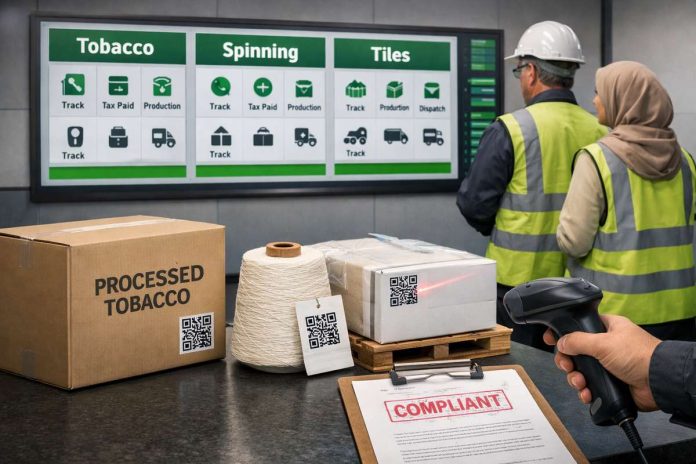
Islamabad – ACT Alliance Pakistan welcomes the Government of Pakistan’s continued crackdown against illegal trade, smuggling, and tax evasion, and strongly supports the Federal Board of Revenue (FBR) and Pakistan Customs for moving enforcement from episodic actions to systems-based compliance. The decision to further strengthen the Track and Trace System (TTS) and electronic monitoring of production across high-risk, revenue-significant sectors is a practical step toward protecting the documented economy and rebuilding investor confidence.
Recent reporting confirms that after implementing TTS in tobacco, sugar, cement, and fertilizer, the FBR is now planning electronic monitoring and TTS expansion to tiles units, textile spinning factories, and Green Leaf Threshing (GLT) units. The same policy direction, shared with the Senate Standing Committee on Finance, cited an estimated Rs 30 billion in annual tax evasion in tiles, and projected that enhanced monitoring can help secure Rs 76 billion in additional revenue from sugar and Rs 102 billion from cement in the current cycle. It also recognized that tax leakage linked to illegal tobacco trade at the GLT stage is estimated at around Rs 80 billion annually.
Mubashir Akram, Country Director, ACT Alliance Pakistan, said: “A competitive market depends on one principle, compliance must not be a disadvantage. When enforcement is technology-driven and consistent, legal businesses can invest, expand, and create jobs without being undercut by illegal operators who pay nothing and follow no rules.”
ACT Alliance Pakistan considers TTS particularly critical in tobacco. Independent research and widely cited assessments consistently place tobacco among Pakistan’s highest-loss tax-evasion sectors. In sector-focused work highlighted in national media, tobacco appears alongside real estate and tyres and lubricants among the largest reported sources of annual tax leakage, which is why a functioning track-and-trace regime in tobacco is not optional, it is a core fiscal safeguard.
The government’s direction on TTS is strengthened by FBR’s recent Request for Information (RFI), which seeks market input on track and trace, electronic monitoring, and advanced authentication options, including forensic-grade and DNA-based or molecular identifiers. This approach signals seriousness about traceability, anti-counterfeiting, and enforcement, while also indicating that future solutions will be designed with technical rigor and operational feasibility in mind.
ACT Alliance Pakistan also recognizes the operational work being carried out by Pakistan Customs against smuggling networks that supply illegal markets and undercut compliant investors. In November 2025, Customs Enforcement Multan seized smuggled cigarettes worth Rs 21.134 million, including 10,701 outer packs and 2.14 million cigarette sticks. In December 2025, Customs Enforcement Peshawar reported multiple interdictions worth Rs 74.4 million, including the interception of three trucks carrying 4,021 sleeves of foreign-origin cigarettes and other contraband.
Mubashir Akram added: “Legal sector companies, local and international, consistently say the same thing. When the state acts against illegal trade and sustains that pressure, formal investment responds. A predictable enforcement environment is a business environment where documented firms can plan, finance, hire, and expand.”
ACT Alliance Pakistan encourages the Government of Pakistan to sustain this momentum by prioritizing full TTS coverage in tobacco, strengthening monitoring at GLT units, and ensuring that expansion to spinning and tiles is implemented with transparent standards, credible auditing, and steady enforcement. Long-term investment follows long-term rule enforcement, and Pakistan is now positioned to make that signal unmistakable.