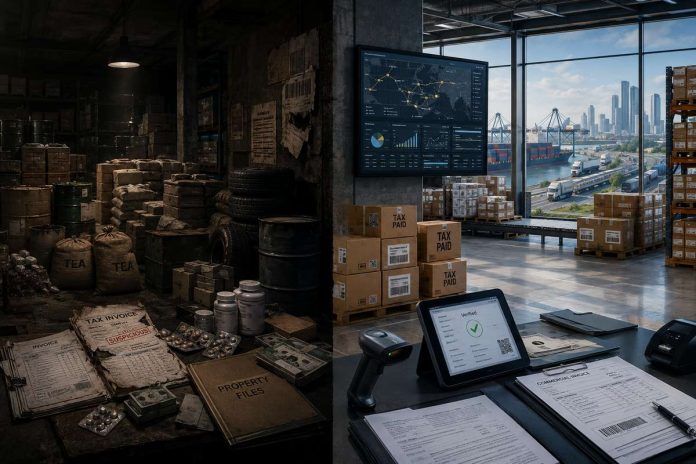
A Year That Exposed the Scale of the Problem
During FY2025–26, Pakistan’s illegal trade problem became harder to dismiss as a collection of isolated smuggling incidents. Government operations uncovered illegal cigarette factories, untaxed tobacco stocks, smuggled petroleum products, non-customs-paid vehicles, misdeclared imports, counterfeit consumer goods, narcotics, precious metals, and prohibited merchandise across the country.
The pattern revealed an extensive illegal commercial system. Goods crossed borders or emerged from undocumented local factories. Transporters moved them to warehouses. Wholesalers introduced them into regular markets. Retailers sold them beside legal products. Cash-based networks financed the chain, while weak prosecution and political protection often reduced the risks faced by those involved.
Official seizures during the year demonstrated stronger enforcement, particularly by the Federal Board of Revenue, Pakistan Customs, Inland Revenue field formations, provincial authorities, Rangers, and other agencies. However, seizures also showed how deeply illegal trade had entered the economy. A state does not repeatedly discover warehouses, factories, fuel consignments, smuggled vehicles, and untaxed retail goods unless the underlying market has become large and organized.
The Pakistan Business Council estimated in 2023 that smuggling, under-invoicing, misdeclaration, counterfeiting, and adulteration together represented about $68 billion, equivalent to roughly 20 percent of the formal economy. It estimated annual tax losses at around Rs. 8 trillion. A later PRIME Institute and TRACIT assessment described Pakistan’s shadow economy as about 40 percent of GDP and placed the country 101st among 158 economies in the 2025 Global Illegal Trade Index.
These studies use different methods and should not be treated as interchangeable. Yet both reach the same conclusion: illegal trade has become a structural economic problem, not a peripheral customs issue.
The FY2025–26 Illegal Trade Mix
The illegal trade mix during the year included border smuggling, local tax-evading production, under-invoicing, misclassification, misuse of exemptions, counterfeit goods, unrecorded real estate transactions, undocumented wholesale and retail commerce, and the movement of profits through cash, hawala, hundi, and other opaque channels.
This distinction matters. Pakistan often discusses illegal trade as if every unlawful product arrives across a border. In reality, a significant share originates inside the country. Illegal manufacturers can procure raw materials, hide machinery, underreport production, evade tax stamps, and distribute their output through ordinary commercial networks. Smuggling and local tax evasion then reinforce each other.
The diversity of seizures reported by FBR during FY2025–26 reflected this mix. Customs operations recovered Iranian petroleum products, foreign cigarettes, food items, cosmetics, toiletries, vehicles, gold, silver, narcotics, and other merchandise. Inland Revenue formations targeted undeclared tobacco processing, illegal cigarette machinery, non-duty-paid stock, and violations across the production chain.
In December 2025 alone, official releases recorded major operations in Karachi, Quetta, Peshawar, Abbottabad, Mardan, Gadani, Sost, Sargodha, and other locations. The geographical spread showed that illegal trade was not confined to one border region. It connected border districts with urban wholesale centers and retail markets throughout Pakistan.
Petroleum: Revenue Leakage Across a Long Supply Chain
Illegal petroleum products remained one of the largest and most visible components of the illegal trade economy. The 2025 PRIME-TRACIT assessment estimated that about 2.8 billion liters of fuel entered Pakistan illegally from Iran and placed the associated annual revenue loss at approximately Rs. 270 billion.
The damage goes well beyond unpaid taxes. Illegal petrol and diesel undercut licensed oil marketing companies and authorized dealers, who bear the tax, safety, storage, transport, and quality-control costs. Legal operators cannot compete fairly with fuel that enters outside the regulated system.
The illegal POL chain also creates wider risks. It involves remote routes, informal depots, modified vehicles, unauthorized retail points, and large cash transactions. Poor-quality or improperly stored fuel can endanger consumers and infrastructure. The same transport and financing networks may move other illegal goods.
FBR’s FY2025–26 releases repeatedly documented seizures of smuggled Iranian diesel and petrol, including operations in Balochistan, Sindh, and Karachi. These actions deserve recognition, but the recurrence of such consignments shows that interception alone cannot solve the problem. Authorities must map the entire chain from border entry to urban sale, identify financiers and depot owners, monitor bulk movements, and take action against retailers who create the final market.
Real Estate: The Quiet Center of Informality
Real estate presents a different form of illegal business practice. Unlike a truck carrying smuggled fuel, property-related tax evasion often hides inside apparently lawful transactions. Under-declaration of sale values, cash payments, anonymous or proxy ownership, speculative files, weak valuation systems, and incomplete reporting allow substantial wealth to remain outside the documented economy.
A widely cited IPSOS study estimated that real estate-related tax evasion could reach about Rs. 500 billion annually. The Pakistan Business Council and the Consortium for Development Policy Research have also examined the high level of informality in real estate, wholesale, and retail markets.
Real estate matters because it can absorb proceeds generated elsewhere in the illegal economy. Profits from smuggling, tax-evading manufacturing, corruption, or unrecorded commerce can be converted into plots, files, houses, and commercial property. Once parked in the property, illegal income may appear to be ordinary capital appreciation.
Pakistan cannot control illegal trade while leaving property transactions opaque. Digital land records, realistic and frequently updated valuations, disclosure of beneficial ownership, integration of federal and provincial databases, and scrutiny of large cash purchases are essential. Reform must also reduce unnecessary complexity so that genuine buyers and sellers can comply without having to navigate conflicting valuations and burdensome procedures.
Tobacco: Conflicting Estimates, One Undeniable Problem
Tobacco was among the most contested sectors during FY2025–26. Available estimates differed considerably. In April 2026, Minister of State for Finance Bilal Azhar Kayani cited an Oxford Economics assessment that more than 25 percent of cigarette production and consumption, about 20 billion sticks, avoided taxes, causing losses of Rs. 137 billion to Rs. 200 billion annually.
Other estimates presented to government officials placed the undocumented volume much higher. A May 2026 meeting at the Ministry of Commerce heard claims that 45 to 47 billion cigarettes were sold untaxed and that annual revenue losses reached about Rs. 350 billion. The PRIME-TRACIT study placed the illegal share at 56 percent and estimated losses above Rs. 300 billion. Conversely, an FBR representative reportedly told a Senate subcommittee in June 2026 that the tax theft estimate was around Rs. 40 billion.
These differences demand transparent official measurement. They do not justify inaction. Even the lower published estimates describe a serious loss of revenue and a major distortion of competition.
During FY2025–26, the government intensified enforcement against illegal cigarette production and non-duty-paid tobacco. The Prime Minister issued directions for action across the supply chain. FBR developed a multilayered enforcement plan, deployed monitoring at Green Leaf Threshing units, sealed factories, dismantled machinery, and seized large quantities of unmanufactured tobacco and finished products.
A December 2025 operation in Mardan was reported to have potential revenue implications of Rs. 19 billion by the government. RTO Abbottabad seized cigarette-making machinery and thousands of tobacco bales. These cases showed that the challenge was not limited to smuggled foreign brands. Undocumented domestic production, undeclared machinery, raw-material diversion, and weak traceability were central parts of the problem.
For legal manufacturers, the effect is direct. They pay Federal Excise Duty, sales tax, corporate taxes, compliance costs, packaging expenses, and monitoring charges. Illegal producers avoid much of this burden and compete through a price advantage created by lawbreaking. That is not competition. It is a transfer of market share from the documented economy to tax evaders.
The Broader Consumer and Industrial Market
Illegal trade also remained significant in tires and lubricants, pharmaceuticals, tea, electronics, cosmetics, food products, vehicles, and other consumer goods. PRIME and TRACIT estimated annual revenue losses of about Rs. 106 billion in tires and lubricants, Rs. 60 billion to Rs. 65 billion in pharmaceuticals, and around Rs. 10 billion in tea.
In pharmaceuticals, the damage includes the danger created by counterfeit, falsified, substandard, or improperly handled medicines. In tires and lubricants, smuggling undermines legal manufacturers and importers and may expose motorists to poor-quality products. In the tea and consumer goods sectors, illegal imports and under-invoicing distort prices and discourage investment in local production.
The December 2025 Karachi operation at Al-Asif, Sohrab Goth, illustrated this mixed-market reality. Customs recovered foreign cigarettes, gutka, food items, cosmetics, toiletries, dairy products, beverages, and other goods from three trucks. Illegal trade rarely respects sectoral boundaries. The same routes, vehicles, storage facilities, wholesalers, and protection systems can handle multiple product categories.
Why Legal Businesses and Investors Pull Back
Illegal trade functions as an unofficial subsidy for noncompliance. A legal company pays customs duties, income tax, sales tax, excise duties, regulatory fees, wages, utilities, safety costs, and documentation expenses. An illegal competitor avoids many of these obligations and uses the savings to sell at lower prices.
The result is a market in which lawful efficiency may matter less than access to illegal supply chains or administrative protection. Legal firms lose sales and reduce production. Their capacity to hire, invest, advertise, expand distribution, and pay future taxes declines. The government then responds to revenue shortfalls by placing greater pressure on the businesses that remain documented, further widening the gap between legal and illegal commerce.
Foreign investors study this environment carefully. They do not focus solely on tax incentives or Pakistan’s population size. They ask whether contracts are enforced, whether intellectual property is protected, whether imported and locally manufactured goods are treated equally, and whether the state can prevent untaxed competitors from taking the market.
An investor may tolerate a high tax rate if the rules remain predictable and apply equally. It is far harder to justify investment when a compliant factory must compete with undeclared machinery, smuggled inputs, fake products, manipulated invoices, and tax-free retail sales. Illegal trade therefore damages Pakistan twice: first by stealing current revenue, and then by preventing future investment and production.
Enforcement Improved, but the System Remains Fragmented
The government’s FY2025–26 enforcement drive showed greater seriousness. Official statements highlighted faceless customs assessment, enhanced scanning, Afghan Transit Trade reforms, bank guarantees, Track and Trace expansion, border improvements, joint operations, and stronger action against tax-evading manufacturers.
These initiatives point in the right direction. Yet Pakistan’s long-standing weakness has been stop-start enforcement. A campaign begins, seizures rise, political attention shifts, and illegal networks rebuild. The Pakistan Business Council has argued that only a whole-of-government approach can produce lasting results.
Pakistan needs a permanent national command structure for illegal trade. Customs, Inland Revenue, FIA, police, provincial administrations, sector regulators, the Financial Monitoring Unit, and prosecutors should share intelligence and pursue common targets. The system must follow goods, money, ownership, transport, storage, and retail distribution rather than treating each seizure as a separate event.
Technology must also move beyond symbolic installation. Track and Trace stamps matter only when officials inspect factories, warehouses, distributors, and retailers. Digital land records matter only when ownership and transaction values can be verified. Customs risk systems matter only when suspicious valuation patterns trigger an investigation. Data must lead to enforcement, and enforcement must lead to prosecution.
The $1 Trillion Test
Pakistan’s official planning ambition is even larger than a $1 trillion economy by 2047. The Planning Ministry has stated a goal of reaching $1 trillion by 2035 and $3 trillion by 2047. That ambition requires investment, productivity, exports, industrial expansion, stronger institutions, and much higher domestic revenue.
An economy cannot reach that scale while illegal operators capture major parts of key markets. Growth does not come only from adding new firms. It also requires protecting productive firms from competitors whose advantage comes from tax theft, smuggling, counterfeiting, or political influence.
Pakistan must therefore curb the illegal trade economy by making it increasingly unprofitable, more detectable, and more punishable. This does not mean indiscriminate action against small livelihoods. It means targeting organized networks, commercial-scale evasion, illegal production, corrupt facilitation, financial backers, warehouses, transporters, and repeat wholesalers and retailers.
The choice is not between enforcement and growth. Enforcement is a condition for growth. It protects revenue, consumers, workers, investors, and legitimate businesses simultaneously.
FY2025–26 showed that the state can act when political direction, institutional coordination, and operational support align. The next task is to make that alignment permanent. Pakistan will not build a trillion-dollar economy by taxing the documented sector more heavily while allowing illegal businesses to take its customers. It will build one by making legality commercially stronger than illegality and by proving that the state’s rules apply across every factory, border, warehouse, property transaction, wholesale market, and retail counter.