Executive Assessment
Pakistan’s petroleum, oil and lubricants market entered 2026 with a fundamental contradiction. On one side stood a large, regulated downstream industry supplying refineries, oil marketing companies, dealers, transporters and industrial users, while collecting substantial taxes and levies for the government. On the other stood a persistent flow of cheaper Iranian petrol and diesel entering through Balochistan, partly through locally permitted border arrangements and partly through channels that carried fuel far beyond authorized areas into Pakistan’s wider commercial market. [1]
The evidence reviewed from January 1 through October 15, 2026 does not support one definitive figure for the illegal market. Estimates vary sharply by date, geography, and definition. In July, the Oil Companies Advisory Council said about 6 million liters per day of smuggled fuel were entering Pakistan, costing the exchequer up to Rs. 280 billion annually. Yet in August the Balochistan government said coordinated enforcement had reduced smuggled Iranian fuel to about 1.2 million liters per day in recent months. Meanwhile, a Senate committee was told in April that local populations were permitted to import up to 3 million liters per day from Iran, down from 6.5 million liters previously. These measure different channels and cannot be treated as the same number. [2]
The strongest conclusion, therefore, is not that one percentage captures the illegal POL economy, but that Pakistan operates a three-layer border fuel system: fully documented commercial imports; locally authorized or tolerated border fuel flows; and illegal movement that escapes taxation or travels beyond authorized markets. That ambiguity itself is part of the enforcement problem.
The Scale of Pakistan’s Legal POL Market
OCAC’s FY2025–26 data provide the clearest benchmark for the documented market. Its member data recorded 16.07 million metric tons of internal energy-product sales, including 7.84 million tons of motor spirit and 7.06 million tons of high-speed diesel across sectors. Road transport alone accounted for about 14.53 million tons. OCAC separately recorded 271,680 tons of non-energy petroleum products, including 162,359 tons of lubricants. Taken together, documented internal energy and non-energy POL volumes were approximately 16.34 million tons during FY2025–26. [3]
That scale explains why even a relatively modest illegal share has major fiscal consequences. The fuel market is also one of Pakistan’s most important revenue-generating commercial systems: petroleum development levies, customs duties, sales-related collections and corporate taxation make the formal chain highly valuable to the state. FBR’s own transformation assessment showed how strongly documentation affects revenue. Between July and November 2025, Petroleum Development Levy collection reached Rs. 706 billion, compared with Rs. 422 billion a year earlier. FBR attributed Rs. 146 billion of the Rs. 284 billion increase specifically to higher fuel volumes moving through the formal supply chain, rather than to levy-rate changes. It also reported identifying 1,576 illegal petrol pumps and sealing 1,442. [4]
That is unusually important evidence: it does not merely estimate the cost of smuggling. It shows that when undocumented fuel was displaced, formal volumes and government receipts rose materially.
The Iran Border: Legal Trade, Local Fuel and Smuggling
The Pakistan-Iran energy relationship cannot simply be described as “smuggling.” Pakistan also conducts lawful energy commerce across the border. At Gabd-Rimdan, Pakistan Customs reported clearing 17,353 metric tons of LPG through 748 Goods Declarations between June 1 and June 8 alone. LPG and bitumen received expedited Green Channel treatment, while revised customs procedures were introduced to counter misdeclaration, concealment, pilferage and unauthorized removal. Customs revenue at the crossing rose to Rs. 12.07 billion during April-June 2026, from Rs. 7.86 billion in the comparable period. [5]
Pakistan and Iran were simultaneously seeking to expand lawful bilateral commerce. In August, their Joint Trade Committee agreed to improve customs coordination, logistics, border infrastructure, barter arrangements and border markets as part of an aspiration to lift bilateral trade to $10 billion annually. [6]
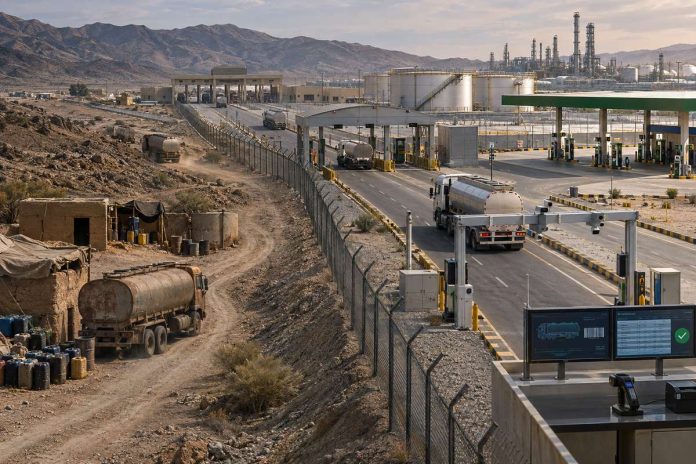
Petrol and diesel are more complicated. On April 14, Customs officials told a Senate subcommittee that local populations could import up to 3 million liters of petroleum products per day from Iran, and that large national OMCs were absent from several areas of Balochistan. The same officials said Customs had no direct operational presence along the Iran border or in Panjgur, Gwadar, Kech and Washuk, operating instead in settled areas. [7]
This helps explain why closing routes alone cannot eliminate border fuel. For some remote communities, it functions as both an energy source and livelihood. But a local concession becomes a national revenue problem when fuel moves beyond restricted areas and competes with tax-paid supply.
The policy ambiguity became clear in April, when the Balochistan government set a price of Rs. 280 per liter for Iranian petrol while saying it would be restricted to the province. By August, provincial officials described a tighter system that limited fuel trade to residents of border districts through designated buffer zones and was not supposed to move beyond those districts. [8]
What Changed Between January and October
The year began with evidence that stronger enforcement was helping documented sales. January OMC sales reached 1.52 million tons, up 10 percent year-on-year; petrol sales were 641,000 tons and HSD 664,000 tons. Market analysts cited improved control over smuggling, along with economic recovery and prices, as contributors. [9]
Regional conflict then destabilized the picture. By March, formal sales were rising sharply, with analysts attributing part of HSD’s 21 percent year-on-year increase to disrupted informal Iranian fuel flows. Yet as border-market conditions shifted, illegal diesel apparently reasserted itself. [10]
May provided perhaps the clearest snapshot of the competitive damage. Legal HSD sales fell to 455,000 tons, down 32 percent year-on-year. OCAC’s secretary general estimated illegal Iranian diesel at 5,000-6,000 tons per day during May and 3,000-4,000 tons per day during June. Iranian diesel reportedly sold around Rs. 220-240 per liter while Pakistan’s official HSD price was substantially higher. The industry warned that the resulting loss of refinery uplift threatened refineries, OMCs and the domestic supply chain. [11]
Using May’s 455,000 tons of legal sales and the industry’s 5,000-6,000-ton daily illegal estimate, illegal diesel would have represented approximately 25.4 to 29 percent of the combined legal-plus-estimated-illegal HSD market that month. That is an analytical calculation based on an industry estimate, not an official government market-share finding. [11]
In July, OCAC escalated its warning, putting total smuggled fuel at about 6 million liters daily, equivalent to 2.19 billion liters if sustained for a full year, and estimating the annual exchequer loss at up to Rs. 280 billion. PRIME’s 2026 review reproduced the same industry warning. [12]
Yet August produced a sharply different official provincial assessment. Balochistan government spokesman Shahid Rind said smuggled Iranian fuel had declined from around 23 million liters per day in October 2023 to approximately 1.2 million liters per day in recent months following enforcement and border-management measures. July OMC sales simultaneously rose 23 percent year-on-year to 1.5 million tons, with analysts linking part of the increase to reduced smuggling. [13]
By September, OMC sales were around 1.3 million tons, and the first quarter of FY2026–27 reached 4.1 million tons, up 6 percent year-on-year, although high fuel prices were suppressing petrol and diesel demand. Through the October 15 cutoff, the evidence therefore suggests improvement from the severe May-July pressure, but not proof that the illegal trade had been eliminated. [14]
The most defensible current annual fiscal benchmark is approximately Rs. 270-280 billion under high-smuggling conditions. PRIME/TRACIT previously estimated around Rs. 270 billion, while OCAC’s July 2026 appeal put the figure at up to Rs. 280 billion. Older intelligence-based reporting estimated that more than $1 billion of Iranian petrol and diesel entered Pakistan annually. [15]
How Much Is Pakistan Actually Losing?
Government revenue performance provides powerful corroborating evidence. In February 2026, FBR’s Member Customs told the National Assembly Standing Committee on Finance that anti-smuggling measures in Balochistan had generated Rs. 188 billion in additional petroleum-sector revenue. FBR separately attributed Rs. 146 billion of the July-November 2025 rise in PDL receipts to higher volumes entering formal channels. Those numbers cannot simply be added together because their periods and revenue concepts may overlap, but they strongly support the conclusion that undocumented fuel historically displaced tax-paying sales on a very large scale. [16]
The business loss extends beyond government tax leakage. Every illegal liter can displace refinery production, OMC sales, licensed dealer turnover, pipeline and transport activity, and working capital inside the documented economy. May’s HSD episode demonstrates the mechanism particularly clearly: industry sources linked the illegal inflow directly to depressed refinery uplift and warned about operational sustainability. [11]
It would nevertheless be misleading to declare a single national illegal-market percentage for all of 2026. Available estimates vary too widely and measure different things. The public record supports a market that was large, volatile, and highly responsive to enforcement, price differentials, and regional disruption, rather than a stable share.
The Framework Pakistan Needs
Pakistan should first separate lawful customs-cleared energy imports, authorized local border fuel, and illegal commercial distribution in its official statistics. Currently, these categories are too easily mixed. Monthly publication of border allocations, provincial fuel offtake, refinery production, imports, OMC sales, seizures, and authorized buffer-zone volumes would let policymakers identify unexplained gaps.
Second, enforcement must move inland. FBR’s Digital Enforcement Stations, scanners, RFID, automatic number-plate recognition, vehicle tracking and centralized intelligence architecture are designed precisely for this purpose. PRIME’s 2026 review, however, found that several digital reforms were still only partially established or under procurement, meaning implementation remains as important as legislation. [17]
Third, the government should protect legitimate Iran-Pakistan commerce while ring-fencing fuel concessions. Efficient LPG and bitumen clearance at Gabd-Rimdan shows that faster legal trade and tighter compliance can coexist. [5]
Finally, Balochistan needs a formal alternative energy market. The Senate record that major OMCs were absent from several areas is not a minor detail. Enforcement will be more durable if licensed dealers, reliable supply, and lawful livelihood opportunities progressively replace dependence on informal border fuel. [7]
The central lesson from January through October 15 is clear: Pakistan has shown that sustained enforcement can move fuel back into the documented market and recover substantial revenue. But the dramatic disagreement between estimates of 1.2 million and 6 million illegal liters per day shows that Pakistan still lacks a transparent, nationally accepted measurement system. Until it establishes one and links border controls with inland tracking, prosecution, and formal supply in Balochistan, the illegal POL economy will remain capable of shrinking under pressure and returning when that pressure weakens.
[1] [7] https://www.senate.gov.pk/en/news_content.php?catid=6&cattitle=Press+Releases&id=NzI0Nw%3D%3D&subcatid=59
[2] [15] https://primeinstitute.org/publication/combating-illicit-trade-in-pakistan-a-framework-for-tracking-progress-on-reforms/
[3] https://www.ocac.org.pk/wp-content/uploads/2022/05/Jul-Jun-2025-26-ENE-Pak-2.pdf
[4] [17] https://download1.fbr.gov.pk/Tenders/20262261024610735FBRTransformationPlan.pdf
[5] https://pid.gov.pk/site/press_detail/32958
[6] https://pid.gov.pk/site/press_detail/33470
[8] https://www.dawn.com/news/amp/1988659
[9] https://www.dawn.com/news/amp/1970949
[10] https://profit.pakistantoday.com.pk/2026/04/02/oil-sales-surge-in-march-despite-price-hikes-middle-east-tensions-to-hit-april-demand
[11] https://epaper.dawn.com/DetailImage.php?StoryImage=28_06_2026_009_007
[12] https://arynews.tv/around-six-million-litres-oil-smuggles-into-country-daily-ocac
[13] https://www.arabnews.pk/pakistan/oil-companies-sales-surge-as-pakistan-cracks-down-on-iranian-fuel-smuggling-2653589
[14] https://www.thenews.pk/print/1440675-omc-sales-fall-2pc-yoy-to-1-3m-tonnes-in-september