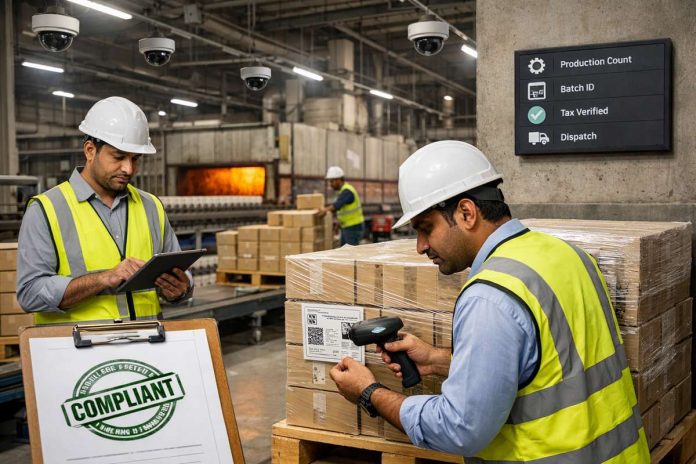
Pakistan’s tile sector has a profile that makes it both economically important and unusually vulnerable to tax evasion and illegal competition. Tile manufacturing is energy-intensive, capital-heavy, and concentrated in identifiable factories. Yet, the market is also exposed to under-invoiced imports and smuggled product flows that depress prices and weaken compliant producers. This combination has pushed the Federal Board of Revenue (FBR) toward a clear conclusion: tiles should be brought under systematic electronic monitoring and Track and Trace System (TTS) controls, similar to the approach already used for other revenue-significant sectors.
A formal policy pathway already exists. In February 2024, the Government of Pakistan issued S.R.O. 308(I)/2024, amending the Sales Tax Rules, 2006, so that the electronic monitoring, tracking, and tracing framework in Chapter XIV-B explicitly includes “tiles” as specified goods.
Business Recorder reported that the purpose was to monitor the production and supply of tiles, and that the change was intended to address sales tax evasion in the sector. The legal basis, therefore, is not theoretical; it is already on the books and provides an implementation foundation that can be expanded with operational rules, vendor standards, and enforcement protocols.
A second, more operational, enforcement track has emerged through production monitoring via cameras and analytics. The News reported that during a Senate Standing Committee on Finance and Revenue briefing, the FBR chairman stated that tiles alone were allegedly involved in annual tax evasion of Rs. 30 billion, and that the FBR would not remove installed cameras, even after requests from four Chinese companies producing tiles in Pakistan.
The same reporting notes that FBR reduced the number of cameras to four per unit, focused on counting produced tiles, and linked the camera program to broader findings of evasion in other monitored sectors. Additional reporting on the same Senate committee briefing indicates that FBR intended the cameras to monitor kilns, packaging areas, and entry and exit points, and that under-declaration of production was described as a routine problem in the sector. This operational push is significant because it shows that FBR is not only updating rules but also field-testing monitoring methods that can be integrated into a complete traceability model.
Market structure data explains why tiles are a sensible candidate for TTS.
Dawn reported that Pakistan’s tile market was around 80 million square meters and that foreign porcelain and ceramic producers had captured over 40 percent of the market, helped by low import prices and smuggling, with smuggled Iranian tiles alone accounting for a little more than 13 percent. The same report noted that six local producers employed about 50,000 people and that local manufacturers had up to 30 percent of their capacity idle due to competitive pressure from imported and smuggled products.
In another Dawn report, the Pakistan Ceramics Manufacturers Association described how undervaluation could reduce the tax paid on imported tiles to extremely low levels per square meter, while locally produced tiles faced far higher sales tax burdens, creating a built-in incentive for evasion and misdeclaration. The Express Tribune also reported that consumption was around six million square meters per month and cited industry claims that illegal tiles had reached roughly 40 percent penetration at one point.
These facts point to a core governance problem: the tile supply chain can be profitable for illegal operators precisely because the product is standardized and easy to substitute. If an importer can under-invoice, misdeclare, or route tiles through smuggling corridors, the market price is pushed down, making it difficult for formal manufacturers to match without cutting corners or under-reporting production.
In that environment, conventional audits and sporadic raids struggle because the state is always reconstructing the facts after the damage is done.
Track and trace works best when production is countable, packaging is standardized, and movement can be reconciled against invoices, which fits tiles. Camera-based production monitoring can establish reliable production numbers at kilns and packing lines. At the same time, a TTS layer can link each pallet or batch to digital records, including manufacturing time, factory identity, and tax status. S.R.O. 308(I)/2024 and the Sales Tax Rules’ Chapter XIV-B framework already point toward real-time monitoring of production, imports, and supply chain for specified goods, which can be operationalized for tiles through secure identifiers and digital reporting.
The purpose is not surveillance for its own sake, but to establish a verifiable chain of evidence that makes under-declaration difficult and enables enforcement to be faster, more objective, and less dependent on discretionary field judgments.
Sustained implementation can also protect legitimate investment. When local producers face a market where imported and smuggled products can avoid a large share of tax and still access mainstream retail, capital investment slows, jobs become less secure, and the sector’s modernization stalls. The same logic that applies to other monitored sectors applies here. If government monitoring raises the probability of detection and increases the cost of evasion, the market begins to reward compliance again. The Rs. 30 billion annual evasion estimate cited in official briefings indicates that the fiscal upside is substantial, and the market and employment figures reported in credible business coverage suggest that the economic upside is equally real.
A practical way forward is therefore clear. Production monitoring cameras should be treated as the measurement layer, while TTS should be treated as the traceability layer that connects measured output to documented movement and tax payment. If these two layers are implemented with clear rules, limited but sufficient factory coverage, and strong data governance, tiles can become a flagship case for how Pakistan shifts from campaign-style enforcement to systems that permanently shrink the space for illegal trade and tax evasion.