Pakistan’s illegal economy is not a collection of isolated market violations. It is a system that rewards tax evasion, weakens lawful businesses, diverts capital into cash-based networks, and reduces the state’s capacity to finance development.
The Pakistan Business Council estimated in 2023 that smuggling, under-invoicing, misdeclaration, counterfeiting, and adulteration together amount to about US$68 billion a year, roughly 20 percent of the formal economy, with an estimated annual tax loss of nearly Rs. 8 trillion. It also warned that illegal trade undermines formal-sector growth, funds crime, and cannot be controlled through stop-start campaigns.
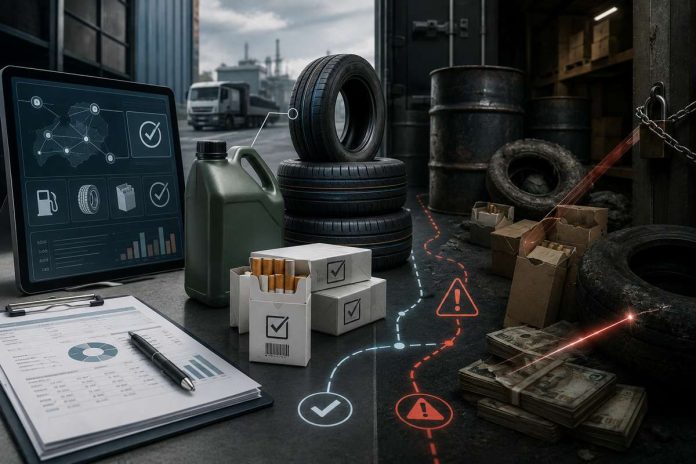
Three sectors illustrate the urgency particularly well: tobacco, petroleum products, and tires and lubricants. A 2025 PRIME Institute and TRACIT assessment estimated that illegal tobacco holds about 56 percent of the cigarette market and causes more than Rs. 300 billion in annual revenue loss. The same study placed the tax loss from smuggled petrol and diesel at about Rs. 270 billion and reported that 2.8 billion liters of fuel enter from Iran through illegal channels. It estimated a further Rs. 106 billion in annual revenue loss from tires and lubricants, with more than 60 percent of tires sold in Pakistan described as smuggled.
These are not minor leakages. Together, the three sectors account for roughly Rs. 676 billion in estimated annual tax loss. Tax loss, however, is only the government’s missing share; it is not the full commercial value of the illegal activity.
If, for policy illustration, the underlying illegal turnover is assumed to be three to four times the taxes evaded, these three markets alone could represent between Rs. 2.03 trillion and Rs. 2.70 trillion in illegal business each year. That range is not an official market estimate, but it demonstrates why tax-loss figures should never be mistaken for the total size of the illegal economy.
The damage extends beyond revenue. Legal cigarette manufacturers, fuel companies, tire producers, importers, distributors, and retailers carry duties, taxes, compliance costs, quality standards, and formal employment obligations. Illegal operators avoid many or all of those costs and can therefore undercut lawful businesses without becoming more efficient. This distorts prices, suppresses documented sales, and makes it harder to justify further investment.
PRIME and TRACIT explicitly conclude that illegal trade penalizes compliant firms, discourages investment, limits job creation, and weakens confidence in the formal economy.
The government’s recent enforcement efforts, therefore, deserve support, but they must become permanent rather than episodic. The Pakistan Business Council recommends a whole-of-government approach built around stronger border controls, provincial cooperation, retail checks, technology, labeling, tighter enforcement, and effective prosecution across the extended chain of evasion. It also calls for action at ports, airports, coastal routes, dry ports, inland transport, warehouses, wholesale markets, and retail outlets.
That is the correct framework. Seizing a consignment matters, but dismantling the network matters more. Enforcement must reach financiers, transporters, warehouse owners, manufacturers, wholesalers, and repeat retailers. Customs, Inland Revenue, police, provincial administrations, regulators, and prosecutors must share intelligence and operate against common targets.
Pakistan should continue and intensify action against every form of illegal business. The objective should not be occasional headlines; it should be a durable shift in market incentives. Legal businesses must know that compliance will be protected, while illegal operators must know that evasion will bring confiscation, prosecution, financial loss, and exclusion from the market.
The economic case is overwhelming. Recovering even part of the losses in tobacco, POL, tires, and lubricants would strengthen revenue without placing another burden on businesses that already pay. More importantly, sustained enforcement would restore fair competition, draw capital back into documented channels, and signal to domestic and foreign investors that Pakistan intends to defend lawful enterprise. Illegal trade has grown into a national economic threat. The government must now reduce it with continuity, coordination, and finality.