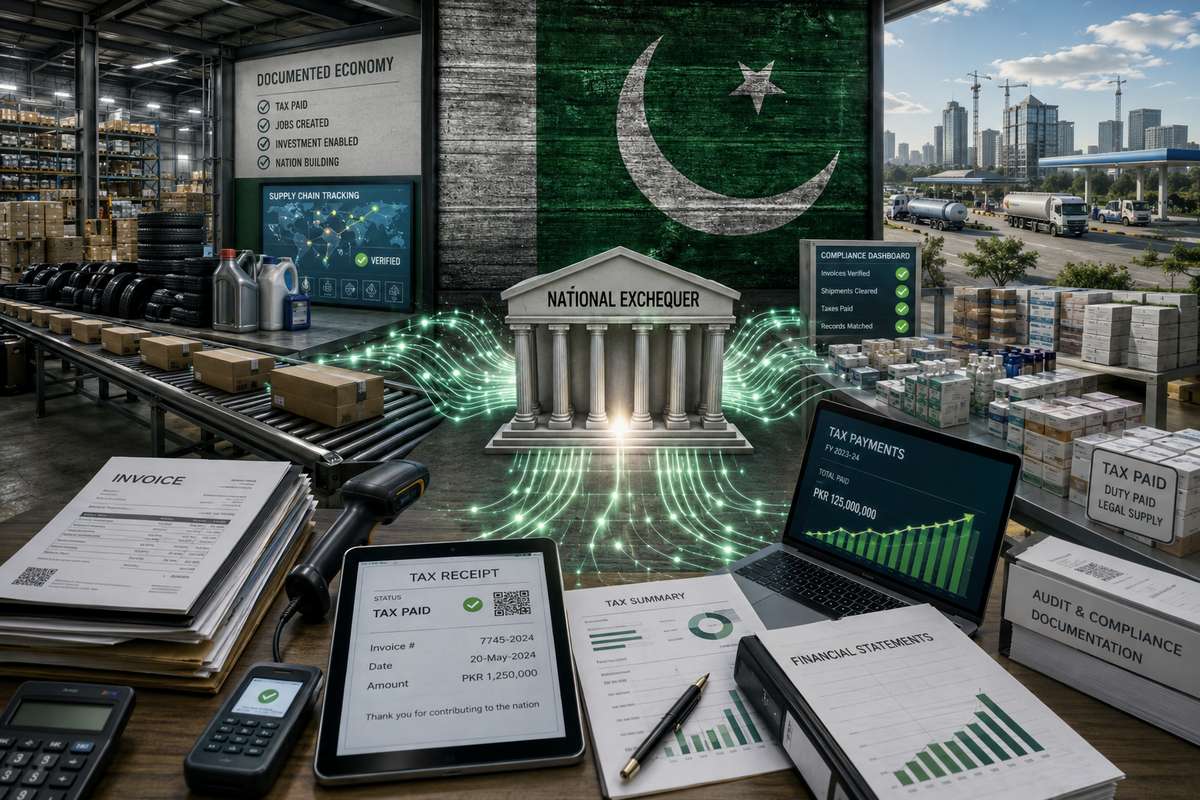
Pakistan’s ambition to become a trillion-dollar economy will depend on far more than headline growth rates. It will depend on whether the state can make legality more profitable than evasion. The government’s own Uraan Pakistan framework is more ambitious than the 2047 benchmark: the Planning Commission has repeatedly stated a target of a $1 trillion economy by 2035 and $3 trillion by 2047.[1] That scale of transformation requires exports, investment, productivity, industrial expansion and a much broader tax base. None of these can develop sustainably while large segments of commerce remain outside taxation and regulation.
The size of the problem is already visible in the available literature. The Pakistan Business Council estimated in 2023 that smuggling, under-invoicing, misdeclaration, counterfeiting and adulteration together were worth about $68 billion, equivalent to roughly 20 percent of Pakistan’s formal economy. It estimated annual tax losses from illegal trade at Rs. 8 trillion.[2] A later PRIME Institute and TRACIT assessment described an informal economy of around $123 billion and cited annual tax revenue losses of Rs. 3.4 trillion, while ranking Pakistan 101st out of 158 countries in the 2025 Illegal Trade Index.[3] The estimates differ because the studies use different definitions and methods, but both point to the same structural problem: a very large share of economic activity escapes the rules that compliant businesses must obey.
For policy purposes, five sectors illustrate the scale particularly clearly: real estate, tobacco, petroleum products, tyres and lubricants, and pharmaceuticals. The figures below should not be treated as one official government dataset because they come from different studies and years. Yet they provide a useful order-of-magnitude picture of the revenue at stake.
Real estate remains the largest single item among the sector-specific estimates. An IPSOS study presented to parliamentarians in 2023 estimated annual tax evasion in real estate at as much as Rs. 500 billion.[4] The study attributed the leakage to weaknesses including poor valuation, under-invoicing and cash transactions. This is especially damaging because property does not merely lose taxes at the point of sale. An opaque real estate market can also absorb undeclared wealth generated elsewhere. If transaction values, ownership and payment channels are not transparent, profits from other forms of evasion can be parked in land and buildings and reappear as apparently legitimate wealth.
Tobacco is another major example. FBR itself said in November 2025 that illegal manufacture and trade in cigarettes was causing an estimated annual revenue loss of roughly Rs. 250 billion to Rs. 300 billion.[5] The 2025 PRIME-TRACIT report placed the illegal cigarette share at 56 percent and used an estimate of more than Rs. 300 billion in annual revenue loss.[3] Whatever figure is ultimately established through a government-supervised market survey, the policy point is difficult to dispute: a legal manufacturer carrying Federal Excise Duty, sales tax, Track and Trace obligations and other compliance costs cannot compete on equal terms with a producer or seller that avoids those costs.
Petroleum products create a similar distortion on a larger physical supply chain. PRIME and TRACIT estimated that around 2.8 billion liters of petrol and diesel were smuggled from Iran and associated the trade with about Rs. 270 billion in annual revenue loss.[3] Illegal fuel does not only deny the exchequer taxes and levies. It disadvantages licensed oil marketing companies, dealers and transporters that pay taxes, maintain safety systems and comply with product and storage standards. When a cheaper illegal substitute is readily available, formal investment becomes less attractive precisely because compliance itself becomes a cost disadvantage.
Tyres and automotive lubricants add another Rs. 106 billion in estimated annual revenue loss, according to the same sector literature originally highlighted in the IPSOS work and subsequently carried into later analyses.[4][3] The underlying mechanism is familiar: smuggling, under-invoicing and informal distribution allow products to reach market below the cost structure faced by legal importers and manufacturers. Pakistan Business Council research has long warned that under-invoicing and misdeclaration undermine formal industry because illegally advantaged imports can enter regular commercial channels with documentation that masks the true value of the transaction.[6]
Pharmaceuticals complete the five-sector picture. The IPSOS-linked estimates place the financial impact of counterfeit and smuggled medicines at about Rs. 60 billion to Rs. 65 billion annually.[4] Here the consequences extend beyond fiscal leakage. Counterfeit, substandard or improperly handled medicines also create direct risks for consumers and weaken confidence in lawful manufacturers, distributors and pharmacies. The state therefore has both a revenue interest and a public-safety interest in controlling the illegal pharmaceutical chain.
A simple addition of these five sector estimates produces an indicative annual tax and revenue loss of roughly Rs. 1.19 trillion to Rs. 1.24 trillion: Rs. 500 billion in real estate, Rs. 250 billion to Rs. 300 billion in tobacco, Rs. 270 billion in petroleum, Rs. 106 billion in tyres and lubricants, and Rs. 60 billion to Rs. 65 billion in pharmaceuticals. This should be read as an illustrative aggregate, not an official consolidated estimate, because the underlying studies differ in timing and methodology. Even so, it demonstrates that the fiscal leakage from only five sectors is already measured in more than a trillion rupees a year.
The wider commercial loss is larger, but it should not be invented by multiplying tax losses with an arbitrary factor. A useful broad benchmark remains the Pakistan Business Council’s $68 billion estimate for the combined value of smuggling, under-invoicing, misdeclaration, counterfeiting and adulteration.[2] That figure captures the scale of illegal commerce, while tax-loss estimates capture only the government revenue foregone. Neither measure fully captures lost legal sales, delayed investment, foregone employment, reduced capacity utilization or the reputational cost imposed on Pakistan as an investment destination.
That distinction is central to the trillion-dollar argument. Legal businesses carry corporate income tax, sales tax, customs duties, regulatory costs, labor obligations, energy bills, financing costs and compliance systems. Illegal operators avoid some or most of these burdens. The result is not merely tax evasion; it becomes state-enabled unfair competition when enforcement fails. The Pakistan Business Council has repeatedly argued that smuggling, under-invoicing and illegal trade weaken manufacturing, discourage scale and place a disproportionate burden on the formal sector.[7] Its investment-climate work similarly warns that tax-policy distortions and a large arbitrage between formal and informal activity push investment away from productive, documented businesses.[8]
Foreign investors notice this. They may accept a demanding tax regime if it is predictable and fairly enforced. They are far less likely to commit capital where a compliant factory, distributor or retailer must compete with untaxed goods, undeclared production, manipulated import values and cash-based operators protected from enforcement. The IMF’s 2025 governance diagnostic reached a related conclusion at the broader institutional level: governance weaknesses, regulatory distortions, poor oversight and political interference suppress investment and revenue, and addressing them could raise Pakistan’s GDP by 5 percent to 6.5 percent over five years.[9]
This is why sustained enforcement is not optional. It is economic infrastructure. Pakistan Business Council’s framework calls for a whole-of-government approach: limiting cash opacity, broadening the tax base, reducing incentives to evade, raising the cost of evasion, strengthening provincial cooperation, using technology and labeling, controlling abuse of transit trade, and prosecuting the extended chain of evasion.[2] PRIME and TRACIT similarly recommend stronger inter-agency coordination, faster judicial procedures, control of raw materials, confiscation and destruction of non-duty-paid goods, and independent measurement of illegal market shares.[3]
The government has already moved in that direction. FBR has expanded enforcement against illegal tobacco production, smuggling and tax violations, while the government in May 2026 reviewed technology-driven measures against underreporting, non-reporting, under-invoicing, tax evasion and smuggling.[10] These initiatives need permanence. A few raids cannot change market incentives if illegal operators expect the pressure to fade after several weeks.
Pakistan therefore needs continuity above all. Enforcement should follow goods from border or factory to warehouse, wholesaler and retail counter. It should follow money through banking, cash and property channels. Technology should link customs declarations, tax stamps, production data, sales records and beneficial ownership. Repeat offenders should face penalties large enough to destroy the economics of evasion, while officials acting lawfully against powerful networks should receive institutional protection.
The government should also resist the temptation to answer every revenue shortfall by increasing the burden on the already documented economy. Reuters reported in June 2026 that Pakistan’s formal businesses and middle class were again facing pressure as the government sought higher revenue while much of the unofficial economy remained outside FBR’s reach.[11] That imbalance cannot support a trillion-dollar transformation. A narrow tax base taxed harder is not a substitute for a broad tax base enforced fairly.
Pakistan’s route to $1 trillion is therefore inseparable from the rule of law in the marketplace. Recovering even part of the estimated Rs. 1.19 trillion to Rs. 1.24 trillion leaking from the five sectors discussed here would strengthen fiscal space. Reducing the wider $68 billion illegal-trade economy would do much more: restore market share to compliant companies, improve capacity utilization, encourage investment, support employment and make future tax collection easier.
The choice is straightforward. Pakistan can continue asking legal businesses to carry an ever-heavier share of the state while illegal competitors operate at a discount, or it can make sustained enforcement a permanent pillar of economic policy. The first path keeps the country trapped in low investment, weak documentation and recurring revenue crises. The second gives its trillion-dollar ambition a credible foundation. A trillion-dollar economy cannot be built on a leaking tax base; it has to be built on a market where paying taxes is normal and evading them is costly.
[1] Ministry of Planning, Development and Special Initiatives, Government of Pakistan, statements on Uraan Pakistan and the targets of a $1 trillion economy by 2035 and $3 trillion by 2047, 2025–2026.
[2] Pakistan Business Council, A Framework to Control Illicit Trade, 2023. The study estimated the combined value of smuggling, under-invoicing, misdeclaration, counterfeiting and adulteration at $68 billion and estimated annual tax loss at Rs. 8 trillion.
[3] PRIME Institute and Transnational Alliance to Combat Illicit Trade, Combating Illicit Trade in Pakistan: A Structural and Policy Analysis, 2025. The report discusses Pakistan’s illegal-trade ranking, informal economy, enforcement weaknesses and sectoral losses, including tobacco, petroleum, pharmaceuticals, tyres and lubricants.
[4] IPSOS findings presented to parliamentarians in 2023, reported by Associated Press of Pakistan, Business Recorder, The News and other publications. The study estimated Rs. 956 billion in annual tax evasion across real estate, tobacco, tyres and auto lubricants, pharmaceuticals and tea, including Rs. 500 billion in real estate.
[5] Federal Board of Revenue, “Action Against Tax Theft in Tobacco Sector; Another Factory Sealed,” November 29, 2025. FBR estimated annual revenue loss from illegal cigarette manufacture and trade at nearly Rs. 250 billion to Rs. 300 billion.
[6] Pakistan Business Council, research on import-value discrepancies and under-invoicing, documenting how under-valued and misdeclared imports reduce customs duty, sales tax and income-tax collections while disadvantaging formal businesses.
[7] Pakistan Business Council, Checklist for Industrialization, identifying smuggling, under-invoicing, illegal trade and the disproportionate tax burden on documented businesses among factors contributing to Pakistan’s premature deindustrialization.
[8] Pakistan Business Council, Improving Pakistan’s Investment Climate, which identifies the tax arbitrage between documented and undocumented activity, policy unpredictability and the unequal tax burden as impediments to investment.
[9] Reuters, November 20, 2025, reporting on the IMF Governance and Corruption Diagnostic. The assessment estimated that addressing systemic governance weaknesses could improve Pakistan’s GDP by 5 to 6.5 percent over five years and identified taxation, regulatory governance, institutional accountability and political interference among key concerns.
[10] Press Information Department, Government of Pakistan, May 13, 2026. Government and FBR officials reviewed technology-driven enforcement measures addressing underreporting, non-reporting, under-invoicing, tax evasion and smuggling.
[11] Reuters, June 11–12, 2026, reporting on Pakistan’s FY2026–27 budget pressures, the burden on formal businesses and taxpayers, and the continuing difficulty of bringing large parts of the unofficial economy within the tax system.


