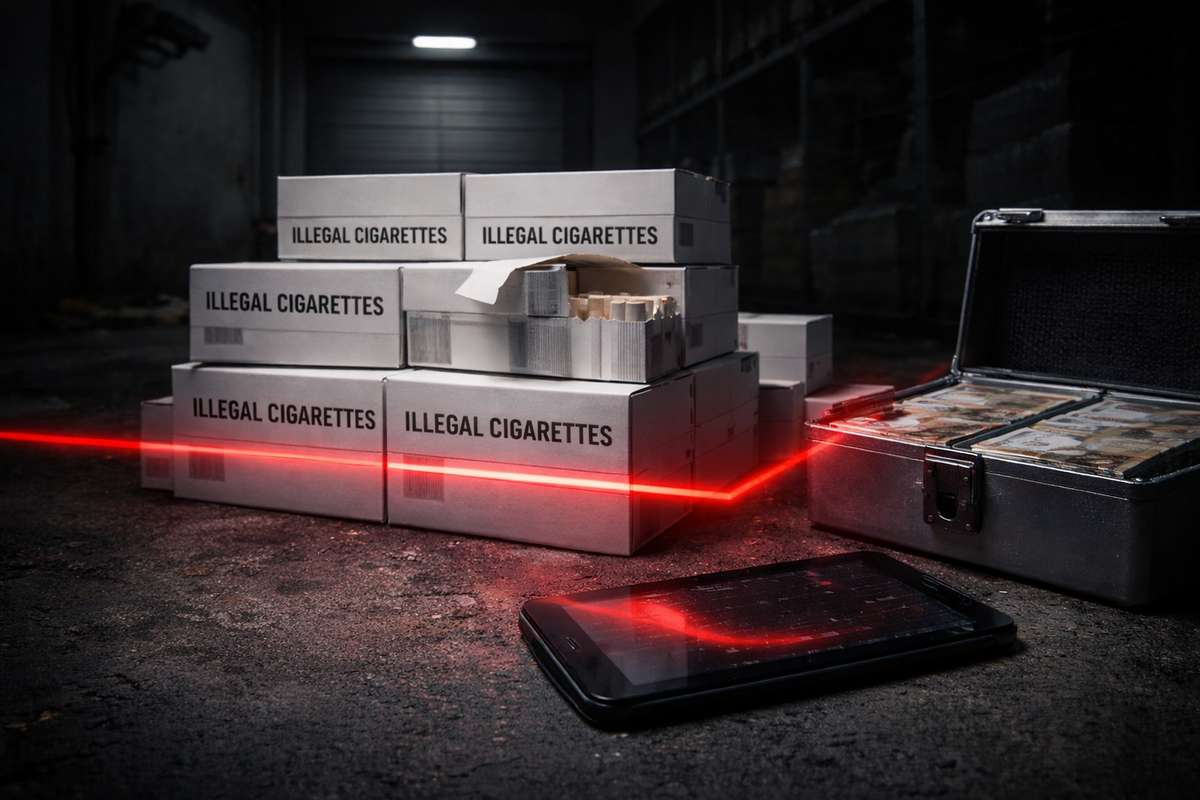
Pakistan’s tobacco sector has become one of the most frequently cited examples of a shadow economy that has grown large enough to distort fiscal policy, weaken enforcement credibility, and reward non-compliance at the point of sale. In public briefings and mainstream reporting, senior tax officials have put the scale of annual tax evasion in tobacco, often discussed alongside poultry, at around Rs. 400 billion, while also conceding that enforcement capacity is not yet sufficient to intercept more than a fraction of illegal movement.
That headline number is important, but it is also incomplete because it reflects foregone tax revenue, not the full commercial footprint of the illegal ecosystem. Pakistan’s cigarette taxation profile indicates that the total tax share of the most sold brand was 60.91 percent in 2024. If taxes represent roughly three-fifths of the legal retail price, then an evaded-tax figure of Rs. 400 billion implies a retail value of illegal cigarettes that can easily exceed Rs. 650 billion in a year, even before accounting for price variation, different product types, and the costs and margins embedded in the illegal supply chain.
When the analysis extends beyond retail value, the “two to three times” estimate becomes a credible risk envelope rather than a single provable statistic. A shadow ecosystem is not only the consumer price of the pack. It also includes upstream raw tobacco diversion, counterfeit inputs such as acetate tow and filters, packaging material, transport, warehousing, cash handling, protection payments, and the losses absorbed through seizures and route disruptions. Pakistan’s enforcement record shows why those upstream components matter, because seizures have increasingly targeted inputs used in non-duty-paid manufacturing, not only finished packs.
The most damaging feature of the shadow tobacco economy is how visibly it now competes at retail, undermining the state’s ability to make tax policy work as intended. A nationwide retail survey reported in January 2026 found 477 cigarette brands in the market. It stated that only 22 brands complied with track-and-trace requirements, while the non-compliant segment included both smuggled brands and locally manufactured non-duty-paid brands. When compliance is that weak at the shop shelf, the market becomes an enforcement referendum, and the state loses its core policy instrument, meaning excise increases.
The fiscal symptoms of this dynamic have already appeared in reported revenue trends. Pakistan’s cigarette sector remains a major contributor to Federal Excise Duty, but reporting based on the FBR annual report indicates that Federal Excise Duty collection from cigarettes fell to around Rs. 225.5 billion in FY 2024–25 from about Rs. 235 billion in the prior year, despite a very large increase in duty rates. The same coverage highlights that the cigarette sector’s share of total FED collection declined sharply. At the same time, overall FED increased, a pattern consistent with illegal substitution and leakage in a high-tax product category.
These numbers matter because they complicate the standard assumption that higher tobacco taxes always produce higher revenue. That can be true in a controlled market, and the WHO has published Pakistan-specific commentary showing that a prior tax increase coincided with a large increase in FED revenue from 2022–23 to 2023–24. The more recent flattening or decline, however, suggests that Pakistan may be approaching a point at which tax rate changes, without simultaneous market control, reallocate consumers toward untaxed supply.
The enforcement picture shows two realities at once. One reality is that the state has intensified operations and is capable of delivering high-impact interdictions. In December 2025, an FBR press release described the seizure of approximately 2.75 million kilograms of non-duty-paid unmanufactured tobacco from godowns in Mardan, with a stated potential revenue implication of around Rs. 19 billion if such inputs were used to feed unlawful production. In October 2025, Pakistan Customs reported intelligence-based multi-city operations that recovered approximately 12.5 metric tons of acetate tow and over 120 metric tons of cigarette-making materials, with the total value of the seizures estimated at above Rs. 1.1 billion.
The other reality is that capacity and retail reach remain the binding constraint. The FBR chairman has been quoted in the press as saying that only one out of every ten trucks carrying smuggled cigarettes is confiscated due to limited workforce and enforcement capacity. If that ratio is even roughly accurate, it means the shadow supply chain can price in seizures as a cost of doing business while retaining a wide market presence.
This is why the shadow economy in tobacco should be treated as a governance and systems problem rather than as a sequence of isolated raids. The illegal chain survives because it has redundancy, meaning multiple suppliers, multiple routes, multiple warehouses, and multiple retail touchpoints. It also survives because it exploits jurisdictional seams, meaning gaps between federal and provincial powers, weak inspection routines, and uneven prosecution outcomes.
Pakistan has started closing some of those seams through formal instruments. In July 2025, the FBR issued an order enabling provincial officers to seize illegal or smuggled cigarettes at retail outlets, warehouses, and in transit, creating a pathway to scale retail enforcement using provincial administrative machinery. This is directionally correct because the retail shelf is where the illegal market becomes cash, and cash is what sustains the ecosystem.
Operationally, the government has also signaled a move toward tighter monitoring at sensitive points in the upstream chain. A government press release in December 2025 described the deployment of monitors under relevant tax laws and the use of Rangers personnel at green leaf threshing units to ensure lawful production and removal, framing the approach as a layered enforcement plan. The policy logic is clear: if raw materials and production volumes are better controlled, illegal output becomes harder to scale.
Even with these measures, Pakistan’s central risk remains consistent. The shadow economy thrives on episodic enforcement because it can pause, reroute, and then resume when pressure fades. A credible counter-illegal strategy, therefore, requires a permanent operating model, not seasonal crackdowns. That model must be visible at retail, predictable to legitimate businesses, and costly to illegal networks every week, not every quarter.
A consistent policy should start with measurable outcomes that are hard to game. The most practical metric is retail compliance, tracked through recurring market sampling that measures the presence of track-and-trace stamps, required warnings, and minimum legal price compliance across urban and rural outlets. When those indicators improve, tax policy regains effectiveness because consumers have fewer non-taxed substitutes.
A second pillar is input control, because the raw material channel is repeatedly highlighted in enforcement actions. Seizures of unmanufactured tobacco and industrial inputs demonstrate that the state can disrupt supply. Still, they also suggest that diversion is currently widespread enough to justify deeper controls on transport, warehousing, and licensing, as well as real-time reconciliation of production inputs with declared output.
A third pillar is prosecution and case finalization. Seizures create headlines, but deterrence is created when illegal operators and their facilitators face predictable legal consequences, including asset seizure where the law allows. Without conviction rates and meaningful penalties, the shadow economy becomes a rational enterprise that budgets for periodic losses.
This is where the issue of political and administrative support systems must be confronted with seriousness and discipline. The shadow tobacco economy is too large to survive without protection, whether that protection is corruption, interference, selective enforcement, or the ability to manipulate inspections and case files. Public reporting on FBR reform has already cited the use of external monitoring to prevent collusion within enforcement teams, indicating that the state recognizes internal integrity as a prerequisite for results. The same principle must be applied systematically in tobacco: rotation of sensitive postings, independent oversight of seizures and evidence handling, audit trails for enforcement decisions, and consequences for officials found facilitating illegal trade.
A fourth pillar is coordinated enforcement architecture. Tobacco is not only an excise issue. It is also a customs, policing, and financial intelligence issue, because the shadow economy is cash-intensive and must be laundered into assets and legitimate channels. The government should institutionalize joint operations combining FBR Inland Revenue, Pakistan Customs, provincial enforcement units empowered under the seizure rules, and financial intelligence bodies to track proceeds.
Pakistan should also calibrate tax policy to enforcement realities rather than to advocacy cycles. Cigarettes remain a top contributor to FED, which means the legal sector’s tax contribution is strategically important to the exchequer. If the illegal market remains dominant at retail, further steep tax increases risk shrinking the legal base and increasing substitution, which can reduce revenue and weaken compliance culture. The government’s priority should be to restore market control first, then set tax policy that delivers both health and revenue outcomes within a controlled market.
The core conclusion is that the shadow tobacco economy in Pakistan is now large enough to be treated as an economic security problem. A Rs. 400 billion annual tax gap, combined with plausible retail and ecosystem scale that can reach two to three times that figure, represents a major pool of untaxed cash operating outside the state’s regulatory perimeter. The government should therefore adopt a consistent, year-round counter-illegal policy that prioritizes retail compliance, input controls, cross-agency operations, and institutional integrity measures to dismantle the protection systems that allow illegal operators to persist.


