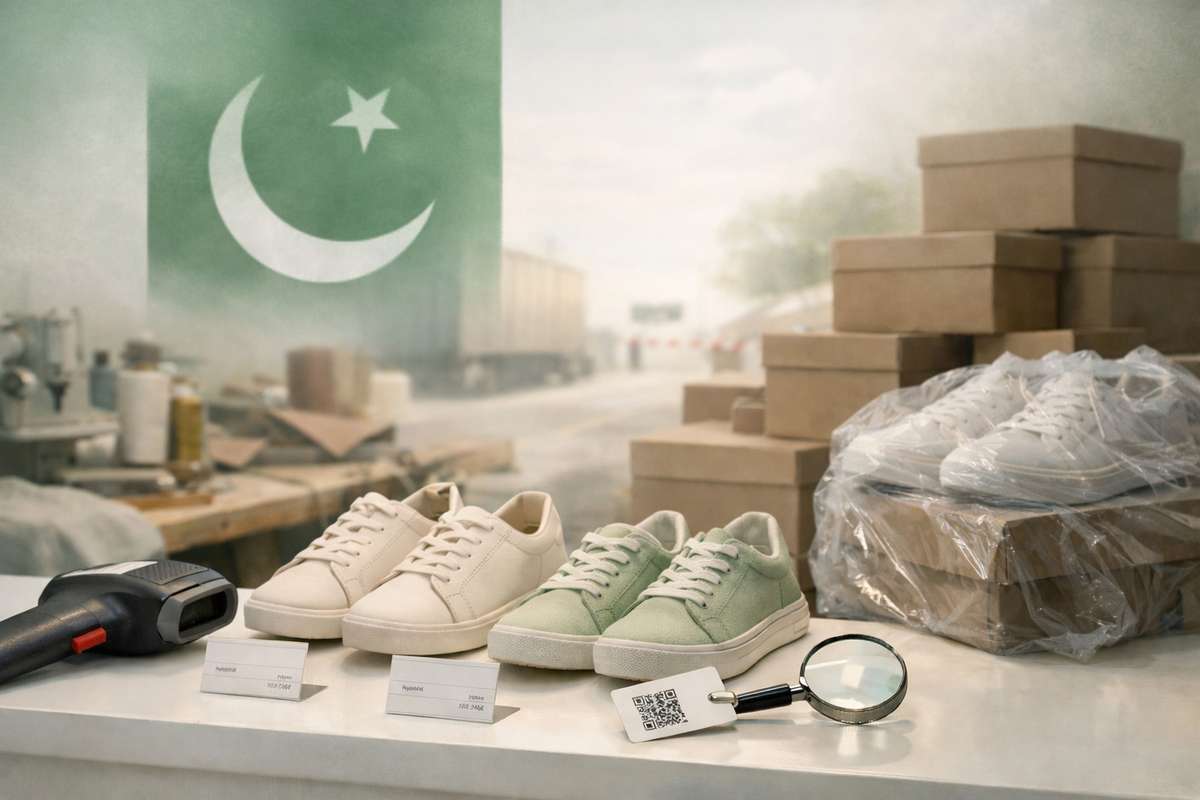
Pakistan’s footwear economy is larger than many policy conversations recognize. That scale is exactly why counterfeit and smuggled shoes have become a material problem for jobs, tax revenue, and investor confidence. Statista’s market forecast estimates Pakistan’s footwear revenue at about US$5.89 billion in 2025, and projects total market volume rising toward roughly 654 million pairs by 2030.
Those numbers describe a mass-market category in which small compliance deviations translate into large distortions in fiscal outcomes.
Pakistan also has real production depth, but the sector is structurally split. A Pakistan Business Council (PBC) study notes that Pakistan is the seventh-largest producer and consumer of footwear globally, accounting for about 2% of worldwide production and about 2.2% of global consumption. The same study describes an industry dominated by the unorganized segment, and reports that around 80% of the documented footwear industry is located in and around Lahore. That combination, high demand plus fragmented supply and uneven documentation, creates an opening for under-invoicing, misdeclaration, counterfeits, and outright smuggling.
The gap between potential and performance is visible in the formal economy’s numbers. Pakistan Bureau of Statistics data, summarized by World Footwear, shows that Pakistan shipped about 21.51 million pairs of shoes between July 2023 and June 2024, generating about US$162 million, with declines in both volume and value. At home, listed firms underscore the scale of legitimate retail; for example, Bata Pakistan reported revenue of about Rs 18.3 billion for the calendar year 2024. When export performance weakens while domestic demand continues to expand, the market becomes even more attractive to low-cost, illegal supply.
At the retail end, counterfeit and smuggled footwear wins through one mechanism, price. A pair that enters without duties, sales tax, and compliance costs can be sold far below the legal price while still delivering strong margins across transport, warehousing, wholesale, and retail.
In the sneakers segment alone, Statista projects revenue of about US$439 million in 2025, which helps explain why joggers and sports shoes attract both counterfeiters and smugglers. Over time, the market becomes trained to treat fake “branded” products as routine commerce, and that weakens incentives for local manufacturers to invest in design, quality control, and marketing.
Public enforcement records offer a rare window into how the pipeline operates. A Quetta case report describes a truck arriving via the Taftan border corridor that was originally loaded with footwear joggers, but later appeared at NLC Dry Port Quetta with large discrepancies, including high-value footwear packages apparently removed in transit and replaced with used clothing. The reported estimated loss to the exchequer was over PKR 8.6 million. Earlier customs reports from Lahore describe interceptions near Saggian Bridge of foreign-origin joggers and shoes allegedly cleared from Quetta for onward supply to Lahore’s wholesale markets, highlighting a recurring pattern: Balochistan-linked routes feeding Punjab’s retail ecosystem.
Counterfeiting is not only a street-market phenomenon. Pakistan Customs’ Intellectual Property Rights Enforcement (IPRE) directorate has reported repeated seizures during FY 2025–26, including shoes and joggers bearing the names and logos of well-known brands.
Reporting on International Customs Day notes 43 seized consignments and an estimated aggregate value of Rs 1.2 billion, with enforcement covering major commercial centers within the Lahore directorate’s jurisdiction, including Lahore, Faisalabad, Sialkot, and Multan. The operational detail that matters for policy is that counterfeit footwear often attempts entry through formal channels, including seaports, airports, and dry ports, which means risk profiling and rights-holder verification can be decisive.
The damage to Pakistan’s local market goes beyond lost sales.
First, illegal supply compresses margins for compliant businesses, which reduces investment in skills, machinery, and formal employment.
Second, counterfeit quality failures erode consumer trust and can damage the reputations of legitimate retailers competing with fakes on price.
Third, investor confidence is directly affected. PBC notes that foreign investment in the leather industry accounts for less than 1% of total FDI inflows and links low foreign collaboration and limited joint ventures to weak upgrading in the organized segment.
Counterfeiting and smuggling are two economic evils that also hit the cigarette, tea, pharma, and consumer products sectors, including the electronics market, at scale, which is why PBC has described illegal trade as systemic rather than episodic.
Pakistan has the tools to reduce the space for counterfeit and smuggled shoes, but only if enforcement becomes routine and predictable. Border and transit controls matter most in corridors that repeatedly appear in enforcement reporting, including the Taftan-Quetta chain and onward movement into Punjab markets. Retail-side discipline is equally important because illegal supply survives by being openly displayed and sold. Intellectual property enforcement needs to remain sustained, because counterfeit consignments can enter through documented trade channels unless detection is consistent. The practical objective is to make illegal supply unstable and expensive, and to make compliance the safer and more profitable choice.
Pakistan’s footwear market has the demand, production base, and retail reach to become a stronger, well-documented industry and a better export performer. That outcome depends on narrowing the price and enforcement gap that currently rewards illegal supply. A market where rules are applied consistently is the kind of market where local brands scale, global brands invest with confidence, and the state collects revenue without repeatedly raising rates on the compliant segment.


