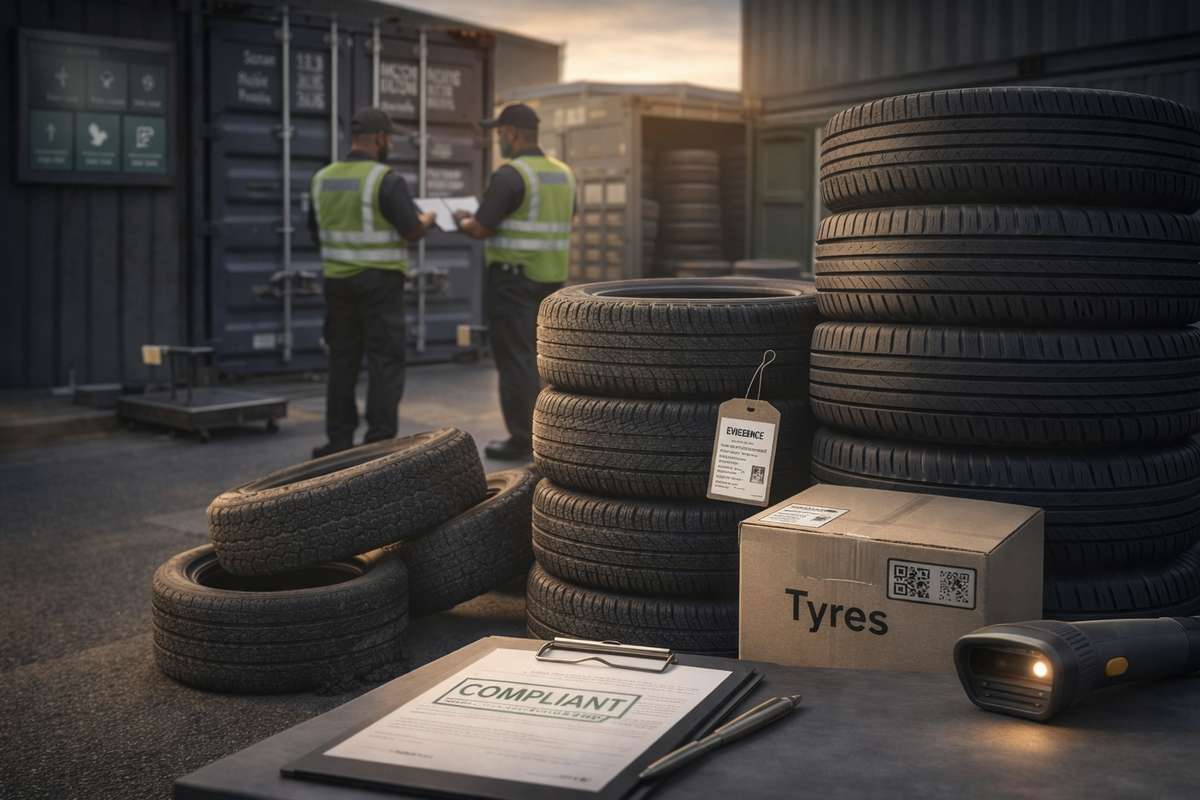
In Karachi’s Old Sabzi Mandi tyre market, enforcement teams have repeatedly found the same pattern: warehouses stacked with foreign-origin, used tyres that are not cleared through documented channels. In March 2025, Customs Enforcement reported seizing more than 5,000 smuggled used tyres from that market alone, valued at about Rs. 75 million. The operational detail matters, multiple warehouses, large-scale movement, and a formal case under the Customs Act, because it points to a supply chain that is stable enough to stock, store, and distribute at industrial volume.
Another way to see the problem is to look at demand. Market and industry reporting commonly places Pakistan’s annual tyre consumption at roughly 14-14.5 million units, excluding motorcycle and rickshaw tyres. At the same time, estimates of “illegal or smuggled” supply repeatedly fall within the 50-65% range, depending on the source and methodology. One Business Recorder report cites a split of about 25% domestic production, 10% legal imports, and the remaining majority supplied through grey channels.
A separate, more granular breakdown presented in reporting on an IPSOS tax-gap study similarly claims that about 65% of the tyre market is met by illegal or smuggled tyres, with roughly 20% locally manufactured and 15% legally imported. That same reporting adds an important nuance: even within “documented” imports, under-invoicing can be material, with industry experts estimating that about 25% of tyre imports are under-invoiced, expanding the loss beyond pure smuggling.
Recent research widely circulated in Pakistan’s anti-illegal-trade debate provides another high-end estimate.
In the PRIME Institute and TRACIT report, the “Tyres and Lubricants” category is presented as having over 60% of the market “smuggled,” with an estimated tax loss of Rs. 106 billion. Whether one accepts the lower bound or upper bound, the consistent conclusion is that a large share of tyres sold in Pakistan bypasses full taxation and compliance requirements.
Because tyres are a derived demand product, timing is sensitive. When the automotive market shows signs of recovery, tyre demand rises with it.
Pakistan Automotive Manufacturers Association data cited in The News shows passenger car sales (PAMA members) rising 60% year-on-year in December 2024, and up 51% for July to December 2024 compared to the same period the prior year. If tyre demand climbs in that environment while illegal supply remains structurally dominant, the fiscal leakage and the damage to compliant business incentives expand in parallel.
From an investigative standpoint, the most revealing feature is how the supply chain is described by both industry and market reporting. One account in The Express Tribune describes containers arriving from Dubai, being unloaded in Karachi, and then distributed across the country.
The same reporting frames Afghan Transit Trade misuse as another pathway, in which tyres brought in under transit arrangements are either unloaded at Karachi or re-enter through smuggling routes from the Afghan border. This is how a market becomes resilient: it is not a single route; it is route redundancy; and it is a commercial network that assumes periodic seizures are a cost of doing business.
Border corridors are repeatedly named in local reporting. Pakistan Observer coverage quoting the tyre industry points to the Chaman, Torkham, and Taftan checkposts as pressure points where tighter control is required. Separate reporting has also described tyres entering through Afghan Transit Trade and then being smuggled into Pakistan via Torkham and Chaman, with additional references to flows connected to Iran. Even where these accounts differ on exact volumes, they align on the core diagnosis, porous corridors, and inconsistent market enforcement allow the price gap to do the work for smugglers.
Urban markets matter as much as border crossings. The Karachi seizures are one example, but not the only one. A practical reading of the trade suggests that once tyres are warehoused and blended into wholesale networks, the retail end becomes “normal commerce,” not a back-alley transaction. Reporting from within tyre markets has described smuggled tyres being openly available across major city centers, a pattern consistent with the economics: tyres are bulky and visible, which means they can only dominate market share if retail risk is low and enforcement is intermittent.
The policy and valuation layer often receives less attention than raids, but it can be decisive. Business Recorder reporting on customs valuation indicates that official import values of tyres and tubes fell sharply between 2020–21 and 2022–23, while the value of tyres and tubes under Afghan transit trade rose dramatically over the same period. In plain terms, when recorded imports contract while recorded transit grows, and consumption remains steady, the system is signaling diversion risk and documentation gaps.
The fiscal cost is reported in several different ways. Business Recorder cites an estimate of more than Rs. 70 billion in annual losses to the exchequer from tyre smuggling alone. The Express Tribune cites an industry claim that the total value of smuggled tyres is about Rs. 300 billion, with revenue loss of over Rs. 50 billion, and also links smuggling directly to blocked investment appetite in the sector. The PRIME and TRACIT work presents a larger “tax loss” figure for tyres and lubricants combined. These differences are not trivial, but they are not contradictory in direction; they reflect differing definitions (smuggling only versus tax gap including under-invoicing and related products) and different evidentiary bases.
Quality and consumer safety add another layer that matters for long-term investor confidence. Multiple reports quote industry concerns that smuggled tyres are often substandard and that mechanical tools are used to make them saleable. Older but still relevant reporting also describes re-stamping and re-dating practices that disguise age and condition. When a market rewards that behavior with high volume, it undermines not only tax compliance but also product standards, insurance outcomes, and road safety, all of which shape the operating environment for formal businesses.
Local manufacturers have been explicit about the investment consequences. The Express Tribune quotes Ghandhara Tyre and Rubber as linking future investment to the state’s ability to stop smuggling, and notes the company’s multi-year investment program.
Separate reporting quotes the industry, arguing that the local sector saves foreign exchange through import substitution and pays taxes, while smuggling undermines the economics that justify capacity expansion. If a firm cannot compete with a majority market segment that avoids duty and sales tax, the rational corporate response is to limit long-term capital commitments.
In that environment, the investor confidence point is not abstract; it is mechanical. A market where illegal supply holds a 50 to 65% share teaches investors that compliance is a competitive disadvantage, that pricing is not market-driven but enforcement-driven, and that forecast accuracy is poor because a parallel supply chain can expand or contract based on enforcement mood rather than consumer preference. This matters for foreign direct investment, but it also matters for domestic expansion, because local capital is equally sensitive to regulatory unpredictability.
Enforcement is clearly possible, but it has to be designed for disruption rather than optics. The Karachi raids show the state can hit warehousing nodes, and repeated seizures suggest that intelligence-led operations are feasible. Yet the persistence of Old Sabzi Mandi as a repeated theatre of action implies the pipeline is still replacing stock quickly, which is what one would expect if financiers, transporters, warehouse operators, and retail channels are not being dismantled as a system.
A credible strategy for tyres typically requires three lines of work running in parallel. One line is border and port enforcement, focused on corridor intelligence and transit-trade controls, because both industry and reporting continue to identify Afghan transit misuse as a core vulnerability. A second line is valuation and documentation tightening, because under-invoicing and distorted import trade price benchmarks reduce tax even on “legal” flows. A third line is domestic market enforcement targeting warehousing, wholesale distribution, and repeat retail violators, so that availability drops and the expected cost of dealing in illegal tyres rises above the profit margin.
Pakistan’s tyre market is large and tied to an auto cycle that appears to be improving after the 2022–24 slump. That makes the moment important. If the state sustains coordinated action across Customs, Inland Revenue, provincial enforcement, and district administrations, the market can be rebalanced toward documented supply.
If it does not, tyre smuggling will remain a high-volume case study in how illegal trade erodes revenue, suppresses investment, and normalizes noncompliance in plain sight.


