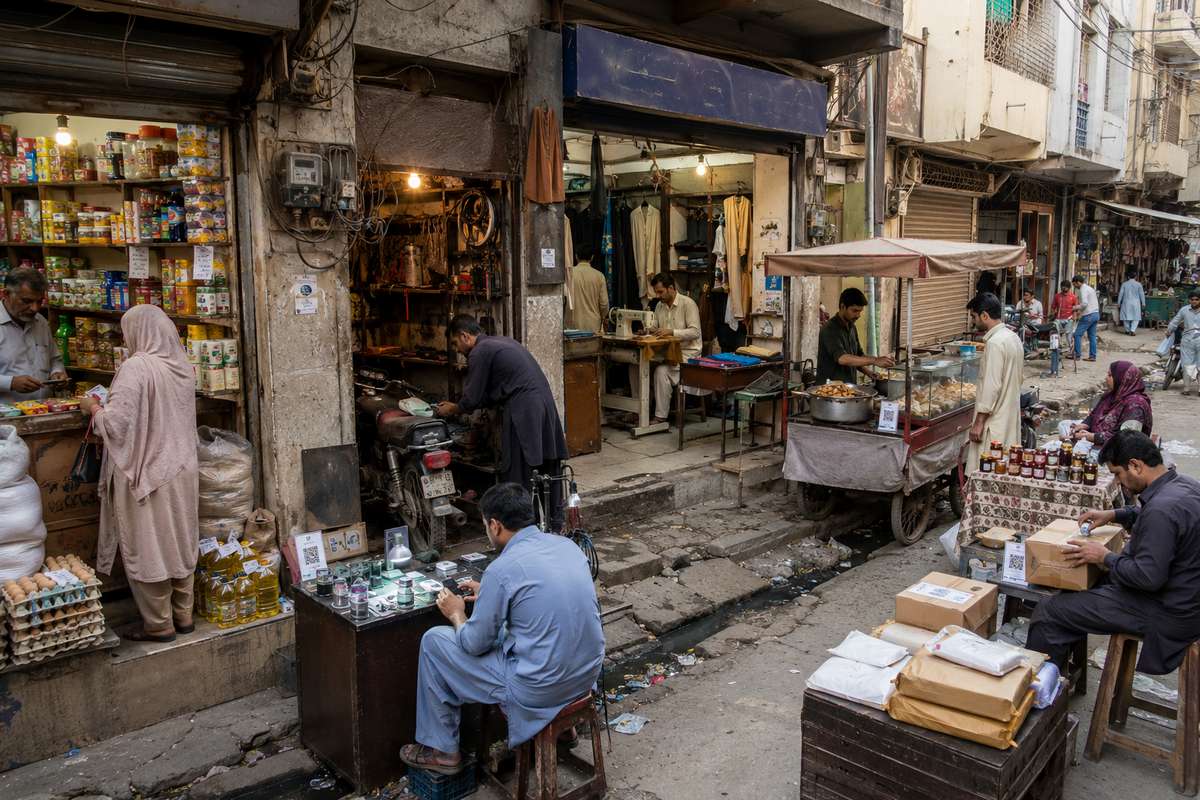
Pakistan’s micro businesses are easy to overlook because most do not appear in corporate surveys, stock-market reports, or investment announcements. Yet they are everywhere: the neighborhood grocery shop, the home-based tailor, the roadside mechanic, the food cart, the mobile-phone repair stall, the small workshop, the beauty salon, the online reseller, and the family unit producing garments, handicrafts, or processed food. Most employ only the owner, relatives, or a handful of workers. They operate with little capital, narrow margins, and almost no protection against economic shocks.
This segment matters because Pakistan lacks sufficient formal jobs. In 2026, the World Bank president said the country would need to create roughly 25-30 million jobs over the next decade. Since most employment comes from the private sector, micro enterprises are not a side issue. They are part of the main employment system. They absorb young workers, women, migrants, and people who cannot enter salaried employment. They also provide basic goods and services in places where larger firms have little commercial interest.
The problem is that Pakistan still treats micro businesses as a vague extension of the broader small and medium enterprise sector. That approach hides their distinct condition. A workshop with eight employees, machinery, audited accounts, and regular bank transactions is not the same as a one-person food stall or a woman stitching clothes from home. Their financing needs, risks, registration capacity, and growth paths differ sharply. Policies that bundle them together usually serve the better-organized firm and leave the smallest business outside the room.
The scale of informality shows why this distinction matters. Pakistan’s Labor Force Survey for 2024–25 classified more than 72 percent of non-agricultural employment as informal. Much of that work is linked to micro businesses. Informality is often described only as tax avoidance, but for the smallest firms, it is also a survival strategy. Registration can entail unfamiliar forms, multiple offices, recurring compliance requirements, uncertain tax exposure, and possible harassment. The owner often sees immediate costs but no reliable gain in credit, public procurement, insurance, or legal protection.
Demand is the first daily struggle. Micro businesses depend heavily on local purchasing power. When food, transport, rent, and utility costs rise, households reduce spending on repairs, tailoring, prepared food, personal care, and nonessential retail. Inflation may slow statistically, but the price level does not return to its previous level. A small shopkeeper must replenish stock at higher prices while customers arrive with thinner wallets. Unlike a large chain, the shop cannot spread losses across branches or negotiate long supplier contracts.
Input costs create the second squeeze. Small producers buy raw materials in modest quantities and therefore pay more per unit. They have little leverage over wholesalers and cannot hedge against currency movements. A baker, welder, printer, barber, or cold-storage retailer also faces energy costs that can destroy a day’s margin. Pakistan’s power minister has publicly called the existing electricity price structure unsustainable, while high tariffs have contributed to weak industrial demand and business closures. Larger firms can install solar systems, generators, or efficient machinery. Many microenterprises cannot afford the initial investment, do not control their rented space, or lack access to financing.
Finance remains the most familiar barrier, but it is often misunderstood. A micro business rarely has formal financial statements, registered collateral, tax records, or a long banking history. Commercial banks, therefore, consider it costly and risky to assess. The owner then relies on savings, relatives, supplier credit, rotating savings groups, or informal lenders. Microfinance helps fill some of the gap, but short repayment cycles and high effective costs can clash with the realities of business investment. A loan for inventory may work. A loan for machinery that begins requiring repayment before it generates income can deepen vulnerability.
Pakistan has taken some positive steps. The National Credit Guarantee Company, launched in 2024 through a partnership involving the Ministry of Finance and Karandaaz Pakistan, was designed to reduce lenders’ risk in financing smaller firms. Digital payment systems such as Raast also create a foundation for low-cost transactions and better business records. The challenge is to reach. A guarantee mechanism aimed mainly at established SMEs may never reach a street vendor, a home producer, or a tiny neighborhood workshop. Digital payments help only when merchants have accounts, customers use them, connectivity works, and transaction histories can support future credit.
Regulation is another maze. A micro entrepreneur may face federal taxation, provincial sales-tax rules, municipal licensing, labor requirements, food or health inspections, market committees, and local police or anti-encroachment action. The legal obligations differ by sector and location, but the common problem is uncertainty. Honest operators often do not know which rule applies, while discretionary enforcement gives an advantage to those with connections. The IMF’s governance diagnostic on Pakistan has also criticized the complexity and distortions of the tax system. For a tiny enterprise, complexity becomes a tax in itself.
Many businesses also lack secure premises. Vendors can lose their location during anti-encroachment drives. Workshop owners face sudden rent increases. Home-based businesses may operate in spaces not designed for production, storage, customers, or delivery riders. Weak roads, drainage, water supply, waste collection, and market security further raise costs. Floods and extreme heat can destroy stock, disrupt supply, and wipe out days of income. Large firms can insure assets and shift operations. A micro business may be one broken freezer or one flooded shop away from closure.
Women face an additional wall. Home-based work gives many women a route into income generation, but it can also keep them invisible. Women may lack property in their names, independent phones, bank accounts, transport, safe market access, childcare, and control over earnings. Research on women’s work in Pakistan has also identified mobility restrictions, harassment, family opposition, and unpaid care burdens as major constraints. A loan alone does not solve these problems. Without market links, digital access, legal identity, and household support, finance can become another obligation rather than a growth path.
Skills are another overlooked issue. Many owners know their trade but not costing, inventory control, branding, bookkeeping, taxation, online selling, or customer data. Public training is often classroom-heavy and disconnected from the business. A tailor does not need a generic entrepreneurship seminar. She may need better product photography, access to reliable fabric suppliers, standardized sizing, digital payments, and a route into online or institutional markets. A mechanic may need diagnostic equipment, certified training, and affordable credit for tools.
The government should begin by recognizing microenterprises as a distinct policy category. Pakistan needs a simple, low-cost registration system that can be completed via a phone or at a local counter. Registration should provide clear benefits: a basic business identity, access to a bank or wallet account, eligibility for small credit guarantees, affordable insurance, training vouchers, and protection against repeated registration demands from different authorities.
Formalization should be gradual, not punitive. A new micro enterprise could enter a simplified turnover-based tax regime with a transition period and clear thresholds. The aim should be to build records and trust before imposing complex obligations. Local governments should create legal vending zones, affordable market spaces, shared storage, sanitation, electricity, and transparent fee schedules. Eviction should not substitute for urban planning.
Finance must move from collateral obsession to cash-flow assessment. Banks, microfinance providers, fintech companies, and credit-guarantee institutions should use verified digital sales records, supplier records, utility payments, and platform histories to assess repayment capacity. Loan products should match business cycles and include grace periods for equipment purchases. Insurance against fire, flood, illness, and stock loss should be bundled in affordable forms.
Government procurement can also create demand. Small contracts for catering, uniforms, repairs, cleaning, furniture, local transport, and supplies can be broken into lots suitable for micro firms. Payments must be fast, because a three-month delay that inconveniences a large company can bankrupt a tiny supplier. Women-owned and home-based enterprises need dedicated market access, not ceremonial quotas that they cannot practically use.
Pakistan should not romanticize micro businesses. Many remain low-productivity activities created by necessity rather than opportunity. The goal is not to preserve every enterprise in its current form. It is to give viable firms a fair chance to become more productive, formal, and durable. Some will remain one-person livelihoods. Others can grow into employers. Both outcomes matter in a country facing an enormous jobs challenge.
The smallest businesses currently face risks that the financial, energy, tax, and urban administration systems have failed to manage. They survive through personal sacrifice, unpaid family labor, and constant improvisation. Pakistan has spent years discussing entrepreneurship while making everyday enterprise unusually difficult. A serious micro-business policy would not begin with slogans about startups. It would begin with lower compliance costs, usable finance, reliable services, a secure market space, and respect for the people already doing business.


